
SK 2015 Q5
5. The diagram shows two circles and a square with sides of length 10 cm. One vertex of the square is at the centre of the large circle and two sides of the square are tangents to both circles. The small circle touches the large circle. The radius of the small circle is \((a - b\sqrt{2})\) cm.
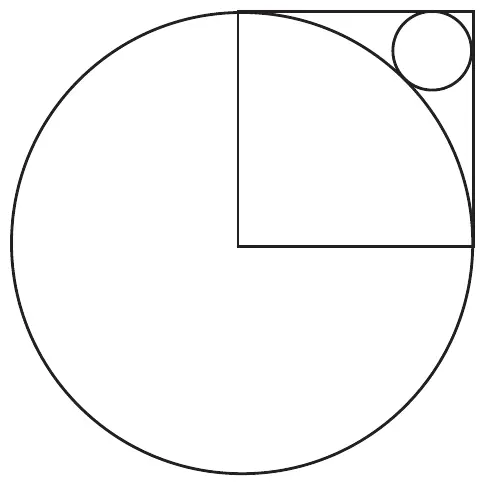
What is the value of \(a + b\)?
Senior Kangaroo 2015, Question 5. © UK Mathematics Trust. Original paper on ukmt.org.uk
Answer: 50
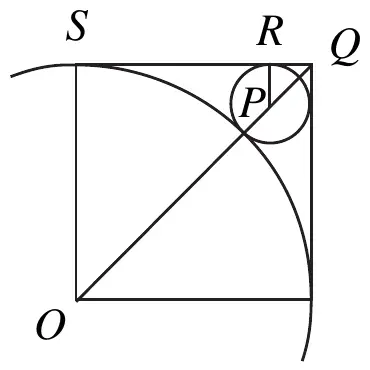
Let \(O\) and \(P\) be the centres of the large and small circles respectively and label points \(Q\) and \(S\) as shown in the diagram. Let the radius of the small circle be \(r\) cm. Draw line \(PR\) so that \(R\) is on \(QS\) and \(PR\) is parallel to \(OS\). Draw in line \(OQ\). Since triangle \(OQS\) is right-angled and isosceles, \(OQ^2 = 10^2 + 10^2\) by Pythagoras. Hence \(OQ = 10\sqrt{2}\) cm. Similarly, since triangle \(PQR\) is right-angled and isosceles, \(PQ = r\sqrt{2}\) cm. Note that angle \(OQS\) = angle \(PQS = 45°\) so \(OPQ\) is a straight line. Therefore \(10\sqrt{2} = 10 + r + r\sqrt{2}\). This has solution
\[r = \dfrac{10(\sqrt{2} - 1)}{\sqrt{2} + 1} = \dfrac{10(\sqrt{2} - 1)(\sqrt{2} - 1)}{(\sqrt{2} + 1)(\sqrt{2} - 1)} = \dfrac{10(2 + 1 - 2\sqrt{2})}{2 - 1} = 30 - 20\sqrt{2}.\]
Hence the radius of the small circle is \((30 - 20\sqrt{2})\) cm and the value of \(a + b\) is \(30 + 20 = 50\).
Solution © UK Mathematics Trust, from the SK 2015 solutions.