
SMC 2014 Q25
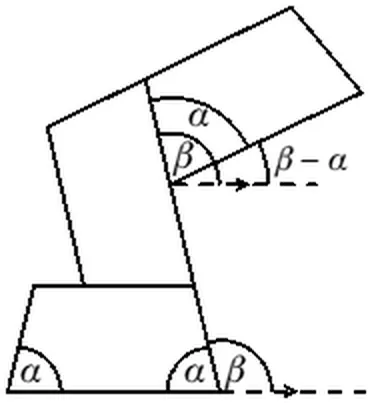
25. Figure 1 shows a tile in the form of a trapezium, where \(\alpha = 83\tfrac{1}{3}°\). Several copies of the tile are placed together to form a symmetrical pattern, part of which is shown in Figure 2. The outer border of the complete pattern is a regular ‘star polygon’. Figure 3 shows an example of a regular ‘star polygon’.

How many tiles are there in the complete pattern?
- A 48
- B 54
- C 60
- D 66
- E 72
Senior Mathematical Challenge 2014, Question 25. © UK Mathematics Trust. Original paper on ukmt.org.uk
Answer: B 54
Let the supplementary angle to \(\alpha\) be \(\beta\). Let tile 1 on the outside of the star polygon be horizontal. Counting anti-clockwise around the star polygon, tile 3 has an angle of elevation from the horizontal of \(\beta - \alpha = 96\tfrac{2}{3}° - 83\tfrac{1}{3}° = 13\tfrac{1}{3}°\). As \(360° \div 13\tfrac{1}{3}° = 27\), we need 27 pairs of tiles to complete one revolution. So there are 54 tiles in the complete pattern.
Solution © UK Mathematics Trust, from the SMC 2014 solutions. Longer versions with investigations: Solutions and investigations (PDF).