
SMC 2014 Q16
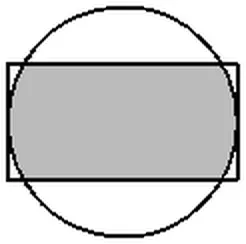
16. The diagram shows a rectangle measuring \(6 \times 12\) and a circle.
The two shorter sides of the rectangle are tangents to the circle. The circle and rectangle have the same centre.
The region that lies inside both the rectangle and the circle is shaded. What is its area?
- A \(12\pi + 18\sqrt{3}\)
- B \(24\pi - 3\sqrt{3}\)
- C \(18\pi - 8\sqrt{3}\)
- D \(18\pi + 12\sqrt{3}\)
- E \(24\pi + 18\sqrt{3}\)
Senior Mathematical Challenge 2014, Question 16. © UK Mathematics Trust. Original paper on ukmt.org.uk
Answer: A \(12\pi + 18\sqrt{3}\)
The diameter of the circle is the same length as the longest sides of the rectangle, so the radius of the circle is 6. The perpendicular distance from the centre of the circle to the longest sides of the rectangle is half of the length of the shortest sides which is 3.
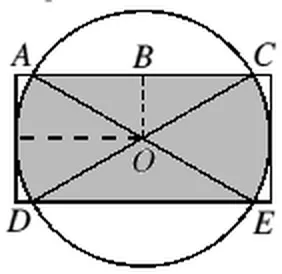
Drawing two diameters \(AE\) and \(DC\) as shown splits the shaded area into two sectors and two isosceles triangles. As \(OA\) is 6 and \(OB\) is 3, \(\angle AOB = 60°\) and, by Pythagoras' Theorem, \(AB = 3\sqrt{3}\). Thus \(\angle AOD = 180° - 2 \times 60° = 60°\). So the shaded area is \(2 \times \dfrac{60}{360} \times \pi \times 6^2 + 2 \times \dfrac{1}{2} \times 2 \times 3\sqrt{3} \times 3 = 12\pi + 18\sqrt{3}\).
Solution © UK Mathematics Trust, from the SMC 2014 solutions. Longer versions with investigations: Solutions and investigations (PDF).