
SMC 2013 Q24
24. The diagram shows two straight lines \(PR\) and \(QS\) crossing at \(O\).
What is the value of \(x\)?
- A \(7\sqrt{2}\)
- B \(2\sqrt{29}\)
- C \(14\sqrt{2}\)
- D \(7(1 + \sqrt{13})\)
- E \(9\sqrt{2}\)
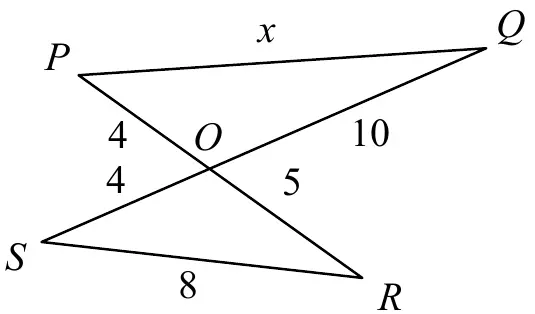
Senior Mathematical Challenge 2013, Question 24. © UK Mathematics Trust. Original paper on ukmt.org.uk
Answer: E \(9\sqrt{2}\)
As they are vertically opposite, \(\angle POQ = \angle SOR\). Let \(\alpha\) denote the size of each of these. Applying the cosine rule to triangle \(SOR\) gives \(8^2 = 4^2 + 5^2 - 2 \times 4 \times 5\cos\alpha\), therefore \(40\cos\alpha = -23\).
Similarly, from triangle \(POQ\) we obtain \(x^2 = 4^2 + 10^2 - 2 \times 4 \times 10\cos\alpha\). So \(x^2 = 16 + 100 - 2 \times (-23) = 162\).
Hence \(x = \sqrt{162} = \sqrt{81 \times 2} = 9\sqrt{2}\).
Solution © UK Mathematics Trust, from the SMC 2013 solutions. Longer versions with investigations: Solutions and investigations (PDF).