
SMC 2012 Q16
16. The diagram shows the ellipse whose equation is \(x^2 + y^2 - xy + x - 4y = 12\). The curve cuts the \(y\)-axis at points \(A\) and \(C\) and cuts the \(x\)-axis at points \(B\) and \(D\). What is the area of the inscribed quadrilateral \(ABCD\)?
- A 28
- B 36
- C 42
- D 48
- E 56
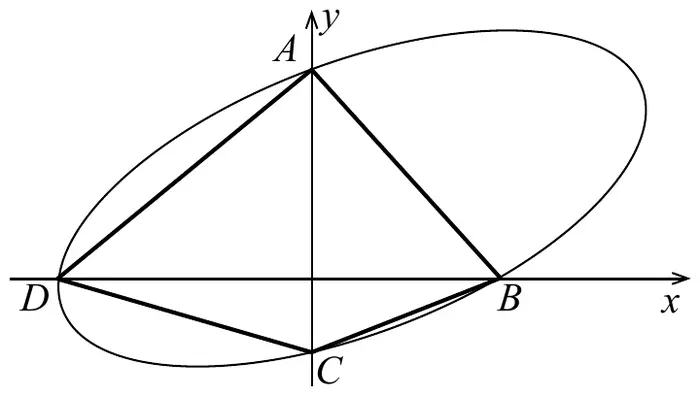
Senior Mathematical Challenge 2012, Question 16. © UK Mathematics Trust. Original paper on ukmt.org.uk
Answer: A 28
At points \(A\) and \(C\), \(x = 0\). So \(y^2 - 4y = 12\), i.e. \((y - 6)(y + 2) = 0\), i.e. \(y = 6\) or \(y = -2\).
So \(C\) is \((0, -2)\) and \(A\) is \((0, 6)\). At points \(B\) and \(D\), \(y = 0\). So \(x^2 + x = 12\), i.e. \((x - 3)(x + 4) = 0\), i.e. \(x = 3\) or \(x = -4\). So \(D\) is \((-4, 0)\) and \(B\) is \((3, 0)\).
Therefore the areas of triangles \(DAB\) and \(DBC\) are \(\tfrac{1}{2} \times 7 \times 6 = 21\) and \(\tfrac{1}{2} \times 7 \times 2 = 7\).
So \(ABCD\) has area 28. {It is left to the reader to prove that area \(ABCD = \tfrac{1}{2}BD \times AC\).}
Solution © UK Mathematics Trust, from the SMC 2012 solutions. Longer versions with investigations: Solutions and investigations (PDF).