
SMC 2011 Q24
24. Three circles and the lines PQ and QR touch as shown. The distance between the centres of the smallest and the biggest circles is 16 times the radius of the smallest circle. What is the size of \(\angle PQR\)?
- A 45°
- B 60°
- C 75°
- D 90°
- E 135°
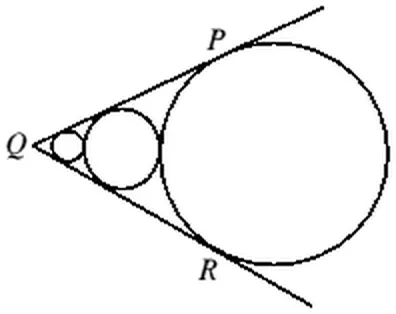
Senior Mathematical Challenge 2011, Question 24. © UK Mathematics Trust. Original paper on ukmt.org.uk
Answer: B 60°
Let the radii of the circles from smallest to largest be \(r_1\), \(r_2\) and \(r_3\) respectively. Hence \(16r_1 = r_3 + 2r_2 + r_1\), thus \(r_3 = 15r_1 - 2r_2 \ldots (1)\). Let \(r_1 + x\) be the distance from \(Q\) to the centre of the smallest circle. By similar triangles,
Thus \(r_1(x + 2r_1 + r_2) = r_2(r_1 + x)\). Hence \(r_2 = \dfrac{r_1x + 2r_1^2}{x} \ldots (3)\). From (1) and (2) \(\dfrac{r_1x}{r_1 + x} = \dfrac{(15r_1 - 2r_2)x}{17r_1 + x}\) hence \(\dfrac{r_1x}{r_1 + x} = \dfrac{15r_1x - 2(r_1x + 2r_1^2)}{17r_1 + x}\). Dividing throughout by \(r_1\) and simplifying gives \(12x^2 - 8r_1x - 4r_1^2 = 0\). Hence \((3x + r_1)(x - r_1) = 0\) so, as \(r_1 > 0\), \(x = r_1\). Thus \(\sin\dfrac{\angle PQR}{2} = \dfrac{r_1}{r_1 + x} = \dfrac{r_1}{2r_1} = \dfrac{1}{2}\). Hence \(\tfrac{1}{2}\angle PQR = 30°\) so \(\angle PQR = 60°\).
Solution © UK Mathematics Trust, from the SMC 2011 solutions. Longer versions with investigations: Solutions and investigations (PDF).