
SMC 2010 Q12
12. The diagram, which is not to scale, shows a square with side length 1, divided into four rectangles whose areas are equal. What is the length labelled \(x\)?
- A \(\dfrac{2}{3}\)
- B \(\dfrac{17}{24}\)
- C \(\dfrac{4}{5}\)
- D \(\dfrac{49}{60}\)
- E \(\dfrac{5}{6}\)
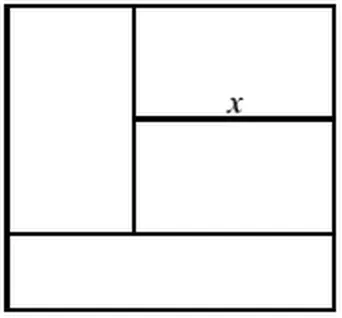
Senior Mathematical Challenge 2010, Question 12. © UK Mathematics Trust. Original paper on ukmt.org.uk
Answer: A \(\dfrac{2}{3}\)
As the square has side length 1 its area is \(1 \times 1 = 1\).
Thus the area of each of the four rectangles is \(\tfrac{1}{4}\).
The length of the bottom rectangle is 1 hence its width is \(\tfrac{1}{4}\).
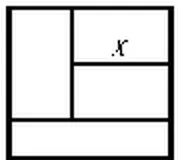
Thus the width of each of the two congruent rectangles is \(\tfrac{1}{2}\left(1 - \tfrac{1}{4}\right) = \tfrac{3}{8}\).
Hence the area of one of these congruent rectangles is \(\tfrac{3}{8}x\).
But we know this area is \(\tfrac{1}{4}\), therefore \(\tfrac{3}{8}x = \tfrac{1}{4}\) and hence \(x = \tfrac{2}{3}\).
Solution © UK Mathematics Trust, from the SMC 2010 solutions. Longer versions with investigations: Solutions and investigations (PDF).