
IMC 2012 Q23
23. In triangle \(PQR\), \(PS = 2\); \(SR = 1\); \(\angle PRQ = 45^\circ\); \(T\) is the foot of the perpendicular from \(P\) to \(QS\) and \(\angle PST = 60^\circ\).
What is the size of \(\angle QPR\)?
- A 45°
- B 60°
- C 75°
- D 90°
- E 105°
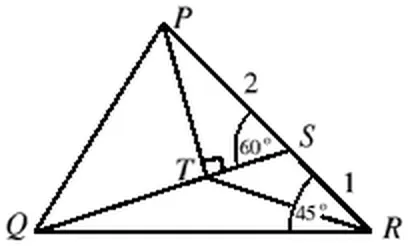
Intermediate Mathematical Challenge 2012, Question 23. © UK Mathematics Trust. Original paper on ukmt.org.uk
Answer: C 75°
As in the solution for Q21, \(\Delta PTS\) may be thought of as half an equilateral triangle, so \(TS\) has length 1 unit. Therefore \(\Delta SRT\) is isosceles and, as \(\angle TSR = 120^\circ\), \(\angle SRT = \angle STR = 30^\circ\). So \(\angle TRQ = 45^\circ - 30^\circ = 15^\circ\). Using the exterior angle theorem in \(\Delta TQR\), \(\angle TQR = \angle STR - \angle TRQ = 30^\circ - 15^\circ = 15^\circ\). So \(\Delta TQR\) is isosceles with \(TQ = TR\). However, \(\Delta PRT\) is also isosceles with \(PT = TR\) since \(\angle PRT = \angle TPR = 30^\circ\). Therefore \(TQ = TP\), from which we deduce that \(PQT\) is an isosceles right-angled triangle in which \(\angle PQT = \angle QPT = 45^\circ\). So \(\angle QPR = \angle QPT + \angle TPS = 45^\circ + 30^\circ = 75^\circ\).
Solution © UK Mathematics Trust, from the IMC 2012 solutions. Longer versions with investigations: Solutions and investigations (PDF).