
IMC 2012 Q21
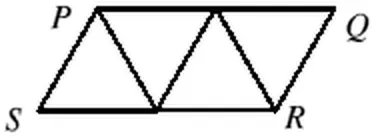
21. The parallelogram \(PQRS\) is formed by joining together four equilateral triangles of side 1 unit, as shown.
What is the length of the diagonal \(SQ\)?
- A \(\sqrt{7}\)
- B \(\sqrt{8}\)
- C 3
- D \(\sqrt{6}\)
- E \(\sqrt{5}\)
Intermediate Mathematical Challenge 2012, Question 21. © UK Mathematics Trust. Original paper on ukmt.org.uk
Answer: A \(\sqrt{7}\)
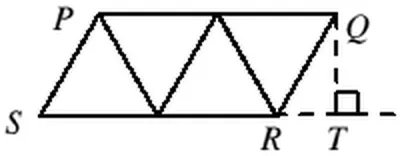
In the diagram, \(T\) is the foot of the perpendicular from \(Q\) to \(SR\) produced. Angles \(PQR\) and \(QRT\) are alternate angles between parallel lines so \(\angle QRT = 60^\circ\). Triangle \(QRT\) has interior angles of 90°, 60°, 30° so it may be thought of as being half of an equilateral triangle of side 1 unit, since the length of \(QR\) is 1 unit. So the lengths of \(RT\) and \(QT\) are \(\tfrac{1}{2}\) and \(\tfrac{\sqrt{3}}{2}\) units respectively.
Applying Pythagoras' Theorem to \(\Delta QST\), \(SQ^2 = ST^2 + QT^2 = \left(\tfrac{5}{2}\right)^2 + \left(\tfrac{\sqrt{3}}{2}\right)^2 = \tfrac{25}{4} + \tfrac{3}{4} = 7\).
So the length of \(SQ\) is \(\sqrt{7}\) units.
Solution © UK Mathematics Trust, from the IMC 2012 solutions. Longer versions with investigations: Solutions and investigations (PDF).