
IMC 2011 Q15
15. The equilateral triangle \(ABC\) has sides of length 1 and \(AB\) lies on the line \(XY\). The triangle is rotated clockwise around \(B\) until \(BC\) lies on the line \(XY\). It is then rotated similarly around \(C\) and then about \(A\) as shown in the diagram.
What is the length of the path traced out by point \(C\) during this sequence of rotations?
- A \(\dfrac{4\pi}{3}\)
- B \(2\sqrt{3}\)
- C \(\dfrac{8\pi}{3}\)
- D 3
- E \(\dfrac{2\pi}{3}\)
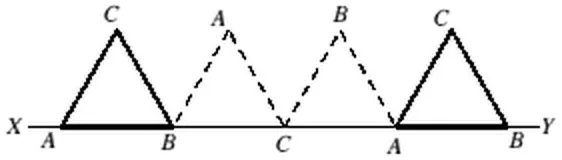
Intermediate Mathematical Challenge 2011, Question 15. © UK Mathematics Trust. Original paper on ukmt.org.uk
Answer: A \(\dfrac{4\pi}{3}\)
In each rotation which \(C\) makes, the radius of the arc it describes is 1 unit. In the first rotation, \(C\) turns through an angle of 120°, so it moves a distance \(\tfrac{1}{3} \times 2 \times \pi \times 1\), that is \(\tfrac{2\pi}{3}\). As it is the centre of the second rotation, \(C\) does not move during it. In the third rotation, \(C\) again turns through an angle of 120°, so the total distance travelled is \(2 \times \tfrac{2\pi}{3} = \tfrac{4\pi}{3}\).
Solution © UK Mathematics Trust, from the IMC 2011 solutions. Longer versions with investigations: Solutions and investigations (PDF).