
IMC 2010 Q25
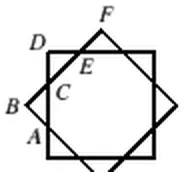
25. Two squares, each of side length \(1 + \sqrt{2}\) units, overlap. The overlapping region is a regular octagon.
What is the area (in square units) of the octagon?
- A \(1 + \sqrt{2}\)
- B \(1 + 2\sqrt{2}\)
- C \(2 + \sqrt{2}\)
- D \(2 + 2\sqrt{2}\)
- E \(2 + 3\sqrt{2}\)
Intermediate Mathematical Challenge 2010, Question 25. © UK Mathematics Trust. Original paper on ukmt.org.uk
Answer: D \(2 + 2\sqrt{2}\)
Let the length of the side of the regular octagon be \(x\) units and let \(A\), \(B\), \(C\), \(D\), \(E\), \(F\) be the points shown. So \(AC = CE = x\).
Now \(\angle ACE\) = 135° (interior angle of regular octagon), so \(\angle ACB\) = 45° and hence triangle \(ABC\) is an isosceles right-angled triangle with \(AB = BC\).
Also, by Pythagoras' Theorem: \(AB^2 + BC^2 = AC^2 = x^2\) so \(AB = BC = \tfrac{\sqrt{2}}{2}x\).
Similarly, \(EF = \tfrac{\sqrt{2}}{2}x\).
Therefore \(BF = \left(\tfrac{\sqrt{2}}{2}x + x + \tfrac{\sqrt{2}}{2}x\right)\) units \(= x(1 + \sqrt{2})\) units.
But we are given that \(BF = (1 + \sqrt{2})\) units so \(x = 1\).
Now the area of the octagon formed by the overlap of the squares is equal to the area of one of these squares minus the sum of the area of four triangles, each of which is congruent to triangle \(CDE\).
Thus, in square units, the required area is
Solution © UK Mathematics Trust, from the IMC 2010 solutions.