
IMC 2008 Q6
6. Four of these shapes can be placed together to make a cube. Which is the odd one out?
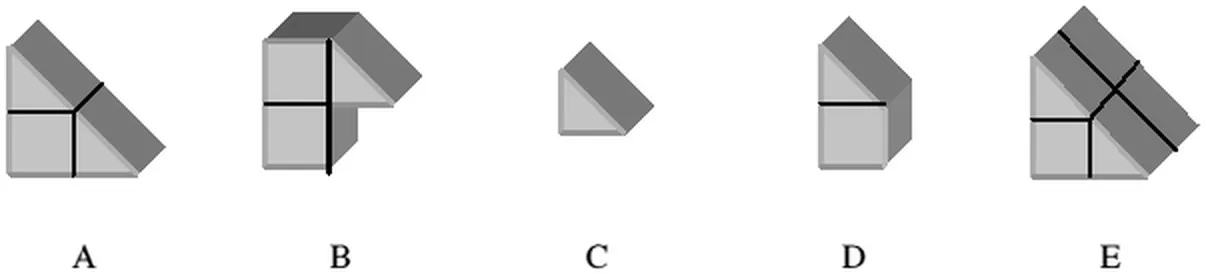
Intermediate Mathematical Challenge 2008, Question 6. © UK Mathematics Trust. Original paper on ukmt.org.uk
Answer: B
Let shape C have width 1 unit, height 1 unit and depth 1 unit. Then the volumes, in units3, of the five shapes are: A 2, B 2\(\tfrac{1}{2}\), C \(\tfrac{1}{2}\), D 1\(\tfrac{1}{2}\), E 4. These total 10\(\tfrac{1}{2}\) units3, so we may deduce that the cube formed by the four shapes will have side 2 units and volume 8 units3. Hence B is the shape which is not required. The cube may be formed by placing C next to D to form a shape identical to A. This combination is then placed alongside A to form a shape identical to E. If shape E is now rotated through 180° about a suitable axis, it may be placed with the combination of shapes A, C and D to form a cube.
Solution © UK Mathematics Trust, from the IMC 2008 solutions.