
IMC 2006 Q22
22. An 8 by 8 chessboard is placed so that a black square is in the top left-hand corner. Starting in the top left square and working along each row in turn, coloured counters are placed, one on each square, following the sequence black, white, red, black, white, red and so on. When the right-hand end of each row is reached, the pattern continues, starting at the left-hand end of the row beneath, until there is one counter on every square.
In the final arrangement, what fraction of the counters are on squares of the same colour as themselves?
- A \(\dfrac{11}{32}\)
- B \(\dfrac{23}{64}\)
- C \(\dfrac{7}{16}\)
- D \(\dfrac{1}{2}\)
- E \(\dfrac{2}{3}\)
Intermediate Mathematical Challenge 2006, Question 22. © UK Mathematics Trust. Original paper on ukmt.org.uk
Answer: B \(\dfrac{23}{64}\)
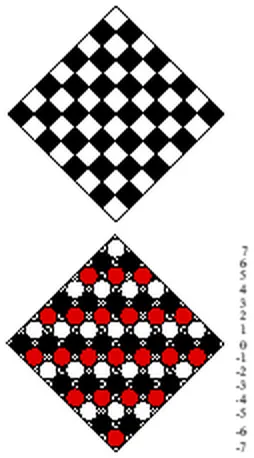
First note that counters of the same colour form diagonal lines across the board. The diagrams show the board before and after the counters are added. In both cases, the board has been rotated 45° anticlockwise. Note that the red counters are shown as grey. Now consider the board to consist of 15 horizontal rows of squares, numbered from 7 to −7 as shown. The only rows in which the colour of the squares on the board matches the colour of the counters are rows 7, 6, 1, 0, −5 and −6. These contain 1, 2, 7, 8, 3 and 2 squares respectively, so the required fraction is 23/64.
Solution © UK Mathematics Trust, from the IMC 2006 solutions.