
IMC 2006 Q21
21. The diagram shows two semicircular arcs, \(PQRS\) and \(QOR\). The diameters, \(PS\) and \(QR\), of the two semicircles are parallel; \(PS\) is of length 4 and is a tangent to semicircular arc \(QOR\).
What is the area of the shaded region?
- A \(2\pi - 2\)
- B \(3\pi\)
- C \(\pi\)
- D 4
- E \(2\pi - 4\)
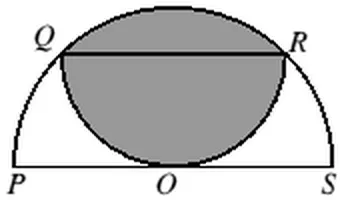
Intermediate Mathematical Challenge 2006, Question 21. © UK Mathematics Trust. Original paper on ukmt.org.uk
Answer: A \(2\pi - 2\)
Let \(T\) be the centre of the semicircle with diameter \(QR\) and let \(OT\) produced meet the circumference of the larger semicircle at \(U\).
By symmetry, we note that \(OT\) is perpendicular to \(QR\).
As \(TR = TO = TQ\) (radii of semicircle), triangles \(ORT\) and \(OQT\) are both isosceles, right-angled triangles. So \(QOR\) is a right angle. By Pythagoras' Theorem: \(QR^2 = OQ^2 + OR^2 = 2^2 + 2^2 = 8\). So \(QR = \sqrt{8} = 2\sqrt{2}\) and the radius of semicircle \(QOR\) is \(\sqrt{2}\).
The area of the shaded region is equal to the area of semicircle \(QOR\) plus the area of the quadrant bounded by \(OQ\), \(OR\) and arc \(QUR\) less the area of triangle \(OQR\). So the required area is \(\tfrac{1}{2}\pi(\sqrt{2})^2 + \tfrac{1}{4}\pi 2^2 - \tfrac{1}{2} \times 2 \times 2 = \pi + \pi - 2 = 2\pi - 2\).
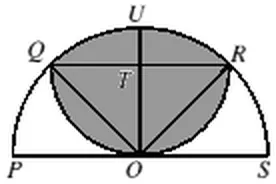
Solution © UK Mathematics Trust, from the IMC 2006 solutions.