
IMC 2004 Q21
21. A square is divided into four congruent rectangles and a smaller square, as shown. (The diagram is not to scale.) The area of the small square is \(\tfrac{1}{4}\) of the area of the whole square. What is the ratio of the length of a short side of one of the rectangles to the length of a long side?
- A \(1 : \sqrt{2}\)
- B \(1 : \sqrt{3}\)
- C \(1 : 2\)
- D \(1 : 3\)
- E \(1 : 4\)
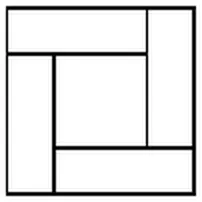
Intermediate Mathematical Challenge 2004, Question 21. © UK Mathematics Trust. Original paper on ukmt.org.uk
Answer: D \(1 : 3\)
Let the length of a short side of a rectangle be \(x\) and the length of a long side be \(y\). Then the whole square has side of length \((y + x)\), whilst the small square has side of length \((y - x)\). As the area of the whole square is four times the area of the small square, the length of the side of the whole square is twice the length of the side of the small square. Therefore \(y + x = 2(y - x)\) i.e. \(y = 3x\) so \(x : y = 1 : 3\).
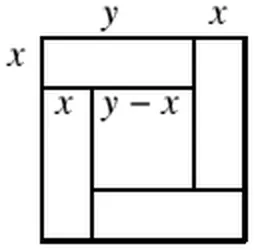
Solution © UK Mathematics Trust, from the IMC 2004 solutions.