
JMC 2013 Q20
20. A ‘long knight’ moves on a square grid. A single move, as shown, consists of moving three squares in one direction (horizontally or vertically) and then one square at right angles to the first direction. What is the smallest number of moves a long knight requires to go from one corner of an 8 × 8 square board to the diagonally opposite corner?
- A 4
- B 5
- C 6
- D 7
- E 8
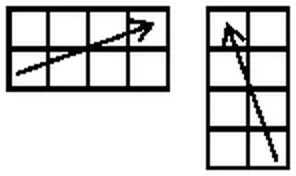
Junior Mathematical Challenge 2013, Question 20. © UK Mathematics Trust. Original paper on ukmt.org.uk
Answer: B 5
The ‘long knight’ needs to move exactly seven squares to the right and exactly seven squares upwards. Although it is possible to move seven squares to the right in three moves (1, 3 and 3), in doing so it could move upwards by a maximum of five squares (3, 1 and 1). Similarly, it could move seven squares upwards in three moves, but could then move a maximum of five squares to the right. In four moves, the number of squares moved to the right must be even, since it is the sum of four odd numbers. So at least five moves are required and the diagram shows one way in which the task may be achieved in five moves.
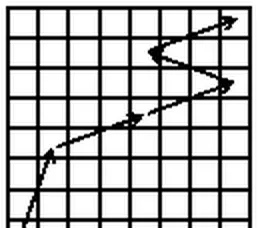
Solution © UK Mathematics Trust, from the JMC 2013 solutions. Longer versions with investigations: Solutions and investigations (PDF).