
JMC 2011 Q25
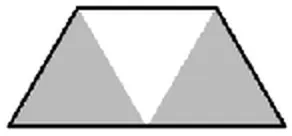
25. The diagram shows a trapezium made from three equilateral triangles.
Three copies of the trapezium are placed together, without gaps or overlaps and so that only complete edges coincide, to form a polygon with \(N\) sides.
How many different values of \(N\) are possible?
- A 4
- B 5
- C 6
- D 7
- E 8
Junior Mathematical Challenge 2011, Question 25. © UK Mathematics Trust. Original paper on ukmt.org.uk
Answer: C 6
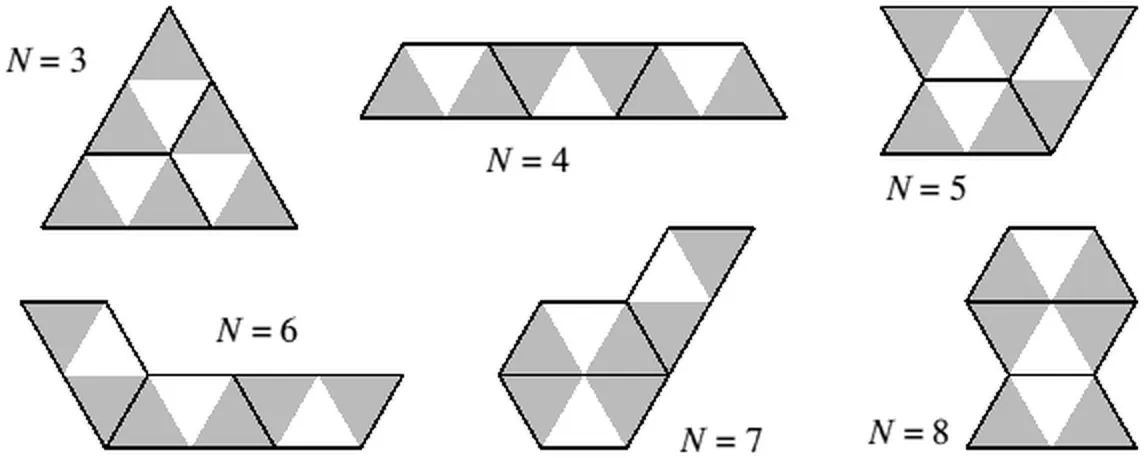
The three trapezia have 12 edges in total. Whenever two trapezia are joined together the total number of edges is reduced by at least 2. Therefore the maximum possible value of \(N\) is 12 − 2 × 2 = 8. As the shapes form a polygon, \(N\) cannot be less than 3. The diagrams below show that all values of \(N\) from 3 to 8 are indeed possible, so there are 6 different values of \(N\).
Solution © UK Mathematics Trust, from the JMC 2011 solutions. Longer versions with investigations: Solutions and investigations (PDF).