
JMC 2008 Q25
25. A large square is divided into adjacent pairs of smaller squares with integer sides, as shown in the diagram (which is not drawn to scale). Each size of smaller square occurs only twice. The shaded square has sides of length 10. What is the area of the large square?
- A 1024
- B 1089
- C 1156
- D 1296
- E 1444
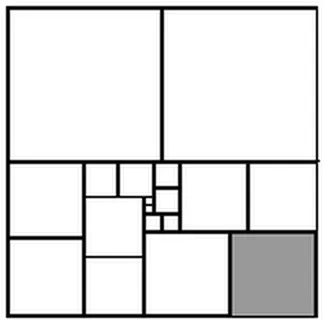
Junior Mathematical Challenge 2008, Question 25. © UK Mathematics Trust. Original paper on ukmt.org.uk
Answer: D 1296
Let the lengths of the sides of the squares, in increasing order, be \(a, b, c, d, e, f, g, h, i\) respectively. So \(h = 10\).
Note that \(c = 2b - a\) and \(d = 2c - 2a = 4b - 4a\). Also, \(e = 2d - a = 8b - 9a\).
As \(h = 2e - 2a - b = 15b - 20a\), we may deduce that \(15b - 20a = 10\), that is \(3b - 4a = 2\).
Since \(a\) and \(b\) are positive integers less than 10, the only possibilities are \(a = 1\), \(b = 2\) or \(a = 4\), \(b = 6\). However, \(h = 10\) therefore \(b\) cannot be greater than 4. So \(a = 1\) and \(b = 2\). It may now be deduced that \(c = 4 - 1 = 3\); \(d = 8 - 4 = 4\); \(e = 16 - 9 = 7\). Also \(2g = 2e + d\), so \(g = 9\).
Now the length of the side of the larger square is \(2h + e + g = 20 + 7 + 9 = 36\), so its area is \(36^2 = 1296\).
(Note that it was not necessary to find the values of f and i, but it is now quite simple to deduce that f = 8 and i = 18.)
Solution © UK Mathematics Trust, from the JMC 2008 solutions.