
JMC 2008 Q13
13. A rectangle \(PQRS\) is cut into two pieces along \(PX\), where \(PX = XR\) and \(PS = SX\) as shown. The two pieces are reassembled without turning either piece over, by matching two edges of equal length. Not counting the original rectangle, how many different shapes are possible?
- A 1
- B 2
- C 3
- D 4
- E 5
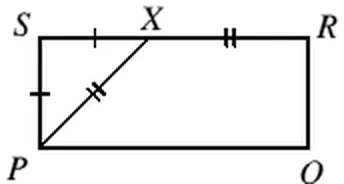
Junior Mathematical Challenge 2008, Question 13. © UK Mathematics Trust. Original paper on ukmt.org.uk
Answer: C 3
New shapes may be formed by joining \(PX\) to \(XR\) (quadrilateral) or \(SP\) to \(RQ\) (parallelogram) or \(XS\) to \(RQ\) (trapezium). Triangle \(SPX\) shows that \(PX\) and \(SX\) have different lengths; and \(PX\) and \(PQ\) have different lengths because \(XR\) is shorter than \(SR\). So there are no other places to position the triangle.
Solution © UK Mathematics Trust, from the JMC 2008 solutions.