
SMC 2008 Q25
25. What is the area of the polygon formed by all points \((x,\ y)\) in the plane satisfying the inequality \(\big|\,|x| - 2\big| + \big|\,|y| - 2\big| \leqslant 4\) ?
- A 24
- B 32
- C 64
- D 96
- E 112
Senior Mathematical Challenge 2008, Question 25. © UK Mathematics Trust. Original paper on ukmt.org.uk
Answer: D 96
To work out the area of \(\big||x| - 2\big| + \big||y| - 2\big| \leqslant 4\), we first consider the region \(|x| + |y| \leqslant 4\) which is shown in (a). This region is then translated to give \(|x - 2| + |y - 2| \leqslant 4\) as shown in (b).
By properties of the modulus, if the point \((x,\ y)\) lies in the polygon, then so do \((x,\ -y)\), \((-x,\ y)\) and \((-x,\ -y)\). Thus \(\big||x| - 2\big| + \big||y| - 2\big| \leqslant 4\) can be obtained from (b) by reflecting in the axes and the origin, as shown in (c).
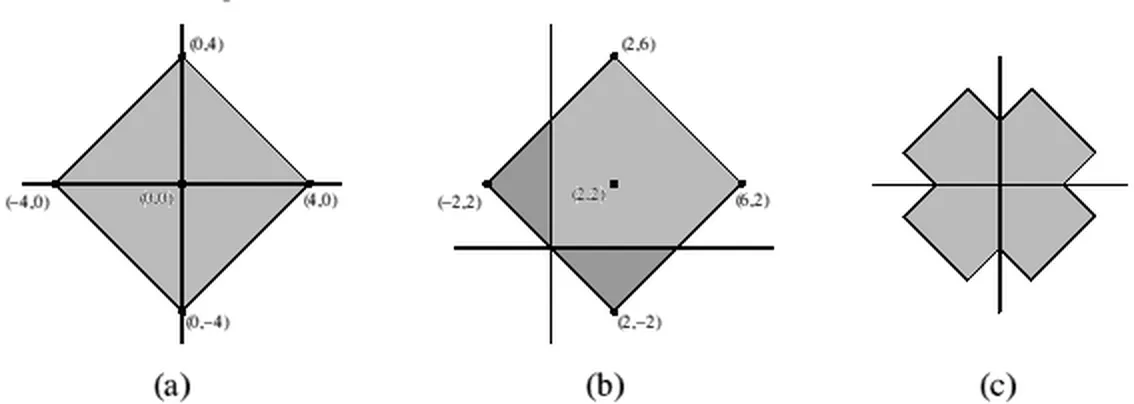
Hence the required area is 4 times the area in the first quadrant. From (b), the required area in the first quadrant is the area of a square of side \(4\sqrt{2}\) minus two triangles (cut off by the axes) which, combined, make up a square of side \(2\sqrt{2}\). So the area in the first quadrant is \((4\sqrt{2})^2 - (2\sqrt{2})^2 = 32 - 8 = 24\).
Hence the area of the polygon is 4 × 24 = 96 square units.
Solution © UK Mathematics Trust, from the SMC 2008 solutions.