
SMC 2008 Q20
20. The diagram shows four semicircles symmetrically placed between two circles. The shaded circle has area 4 and each semicircle has area 18. What is the area of the outer circle?
- A \(72\sqrt{2}\)
- B 100
- C 98
- D 96
- E \(32\sqrt{3}\)
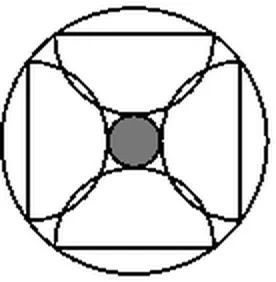
Senior Mathematical Challenge 2008, Question 20. © UK Mathematics Trust. Original paper on ukmt.org.uk
Answer: B 100
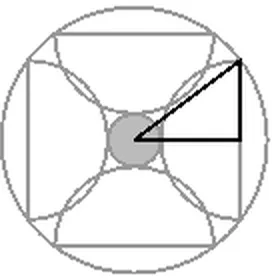
Let \(r_1\), \(r_2\) and \(r_3\) be the radii of the shaded circle, semicircles and outer circle respectively. A right-angled triangle can be formed with sides \(r_3\), \((r_1 + r_2)\) and \(r_2\).
Hence, by Pythagoras' Theorem, \(r_3^2 = (r_1 + r_2)^2 + r_2^2\).
Now \(\pi r_1^2 = 4\), hence \(r_1 = 2\,/\sqrt{\pi}\). Likewise \(r_2 = 6\,/\sqrt{\pi}\).
Hence \(r_2 = 3r_1\) so that \(r_3^2 = (r_1 + 3r_1)^2 + (3r_1)^2 = 25r_1^2\). Thus the required area is 25 × 4 = 100.
Solution © UK Mathematics Trust, from the SMC 2008 solutions.