
SMC 2007 Q24
24. A paperweight is made from a glass cube of side 2 units by first shearing off the eight tetrahedral corners which touch at the midpoints of the edges of the cube. The remaining inner core of the cube is discarded and replaced by a sphere. The eight corner pieces are now stuck onto the sphere so that they have the same positions relative to each other as they did originally. What is the diameter of the sphere?
- A \(\sqrt{8} - 1\)
- B \(\sqrt{8} + 1\)
- C \(\tfrac{1}{3}(6 + \sqrt{3})\)
- D \(\tfrac{4}{3}\sqrt{3}\)
- E \(2\sqrt{3}\)
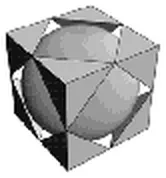
Senior Mathematical Challenge 2007, Question 24. © UK Mathematics Trust. Original paper on ukmt.org.uk
Answer: D \(\tfrac{4}{3}\sqrt{3}\)
The diameter of the sphere is \(l - 2h\) where \(l\) is the length of a space diagonal of the cube and \(h\) is the perpendicular height of one of the tetrahedral corners when its base is an equilateral triangle.
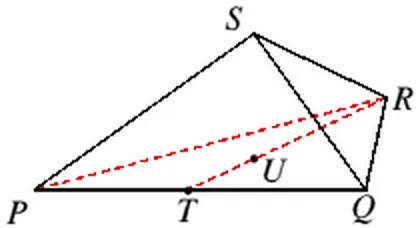
The diagram shows such a tetrahedron: \(S\) is a corner of the cube; the base of the tetrahedron, which is considered to lie in a horizontal plane, is an equilateral triangle, \(PQR\), of side \(\sqrt{2}\) units; \(T\) is the midpoint of \(PQ\). Also \(U\) is the centroid of triangle \(PQR\), so \(RU : UT = 2 : 1\). As \(U\) is vertically below \(S\), the perpendicular height of the tetrahedron is \(SU\).
As \(RTP\) is a right angle, \(RT^2 = RP^2 - TP^2 = (\sqrt{2})^2 - \left(\tfrac{\sqrt{2}}{2}\right)^2 = \tfrac{3}{2}\). Also, \(RU = \tfrac{2}{3}RT\), so \(RU^2 = \tfrac{4}{9}RT^2 = \tfrac{4}{9} \times \tfrac{3}{2} = \tfrac{2}{3}\).
So \(SU^2 = SR^2 - RU^2 = 1 - \tfrac{2}{3} = \tfrac{1}{3}\). Therefore \(h = \tfrac{1}{\sqrt{3}} = \tfrac{1}{3}\sqrt{3}\).
Now \(l^2 = 2^2 + 2^2 + 2^2 = 12\), so \(l = \sqrt{12} = 2\sqrt{3}\). Therefore the diameter of the sphere is \(2\sqrt{3} - 2 \times \dfrac{\sqrt{3}}{3} = \dfrac{4\sqrt{3}}{3}\).
Solution © UK Mathematics Trust, from the SMC 2007 solutions.