
SMC 2006 Q24
24. A solid red plastic cube, volume 1 cm3, is painted white on its outside. The cube is cut by a plane passing through the mid-points of various edges, as shown.
What, in cm2, is the total red area exposed by the cut?
- A \(\dfrac{3\sqrt{3}}{2}\)
- B 2
- C \(\dfrac{9\sqrt{2}}{5}\)
- D 3
- E \(\dfrac{3(\sqrt{3} + \sqrt{2})}{4}\)
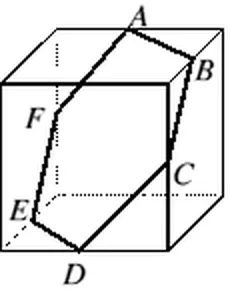
Senior Mathematical Challenge 2006, Question 24. © UK Mathematics Trust. Original paper on ukmt.org.uk
Answer: A \(\dfrac{3\sqrt{3}}{2}\)
Let \(O\) be the centre of the cube. Consider triangle \(ABO\): from Pythagoras' Theorem, \(OA = AB = BO = \sqrt{\left(\tfrac{1}{2}\right)^2 + \left(\tfrac{1}{2}\right)^2}\) cm \(= \tfrac{1}{\sqrt{2}}\) cm. So triangle \(OAB\) is equilateral.
A similar argument may be applied to triangles \(OBC\), \(OCD\) etc. The area of each of these equilateral triangles is \(\tfrac{1}{2} \times \tfrac{1}{\sqrt{2}} \times \tfrac{1}{\sqrt{2}} \times \sin 60°\) cm2, that is \(\tfrac{1}{8}\sqrt{3}\) cm2. So the area of hexagon \(ABCDEF\) is \(6 \times \tfrac{\sqrt{3}}{8}\) cm2. However, the total red area exposed by the cut is twice the area of this hexagon, that is \(\tfrac{3\sqrt{3}}{2}\) cm2.
Solution © UK Mathematics Trust, from the SMC 2006 solutions.