
SMC 2006 Q23
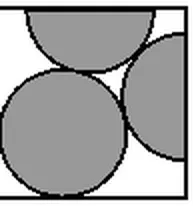
23. In the diagram, the circle and the two semicircles have radius 1.
What is the perimeter of the square?
- A \(6 + 4\sqrt{2}\)
- B \(2 + 4\sqrt{2} + 2\sqrt{3}\)
- C \(3\sqrt{2} + 4\sqrt{3}\)
- D \(4 + 2\sqrt{2} + 2\sqrt{6}\)
- E 12
Senior Mathematical Challenge 2006, Question 23. © UK Mathematics Trust. Original paper on ukmt.org.uk
Answer: D \(4 + 2\sqrt{2} + 2\sqrt{6}\)
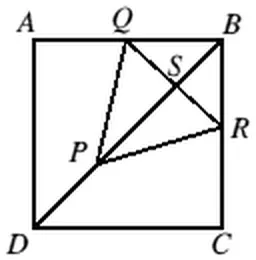
Let the vertices of the square be \(A\), \(B\), \(C\), \(D\) and the centres of the circle and the two semicircles be \(P\), \(Q\), \(R\), as shown. The midpoint of \(QR\) is \(S\). By symmetry, \(P\) and \(S\) both lie on diagonal \(BD\) of square \(ABCD\) and the whole figure is symmetrical about \(BD\).
As \(P\) is distance 1 from both \(AD\) and \(DC\), the length of \(DP\) is \(\sqrt{2}\).
As the circles and semicircles are mutually tangent, \(PQR\) is an equilateral triangle of side 2, so the length of \(PS\) is \(\sqrt{3}\). As angles \(QBS\) and \(BSQ\) are 45° and 90° respectively, triangle \(SBQ\) is isosceles, so \(SB = SQ = 1\). Hence the length of \(BD\) is \(\sqrt{2} + \sqrt{3} + 1\). Now the length of the side of the square is \(BD \div \sqrt{2}\) so the perimeter of the square is \(4 \times (BD \div \sqrt{2})\), that is \(2\sqrt{2} \times BD\).
So the perimeter is \(2\sqrt{2}\,(\sqrt{2} + \sqrt{3} + 1)\), that is \(4 + 2\sqrt{6} + 2\sqrt{2}\).
Solution © UK Mathematics Trust, from the SMC 2006 solutions.