
SMC 2006 Q21
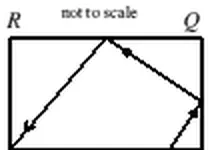
21. A toy pool table is 6 feet long and 3 feet wide. It has pockets at each of the four corners \(P\), \(Q\), \(R\) and \(S\). When a ball hits a side of the table, it bounces off the side at the same angle as it hit that side. A ball, initially 1 foot to the left of pocket \(P\), is hit from the side \(SP\) towards the side \(PQ\) as shown.
How many feet from \(P\) does the ball hit side \(PQ\) if it lands in pocket \(S\) after two bounces?
- A 1
- B \(\dfrac{6}{7}\)
- C \(\dfrac{3}{4}\)
- D \(\dfrac{2}{3}\)
- E \(\dfrac{3}{5}\)
Senior Mathematical Challenge 2006, Question 21. © UK Mathematics Trust. Original paper on ukmt.org.uk
Answer: B \(\dfrac{6}{7}\)
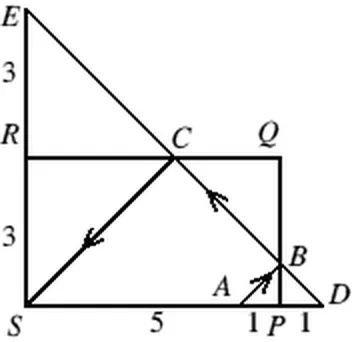
The route of the ball is \(A \rightarrow B \rightarrow C \rightarrow S\). The diagram also shows point \(D\), the reflection of point \(A\) in \(PQ\), and point \(E\), the reflection of point \(S\) in \(QR\). As the ball bounces off a side at the same angle at which it hits that side, points \(D\), \(B\), \(C\), \(E\) lie in a straight line.
Triangles \(DPB\) and \(DSE\) are similar since both are right-angled and they have a common angle at \(D\). So \(\tfrac{BP}{PD} = \tfrac{ES}{SD} = \tfrac{6}{7}\). Hence \(BP = \tfrac{6}{7}\).
Solution © UK Mathematics Trust, from the SMC 2006 solutions.