
SMC 2006 Q17
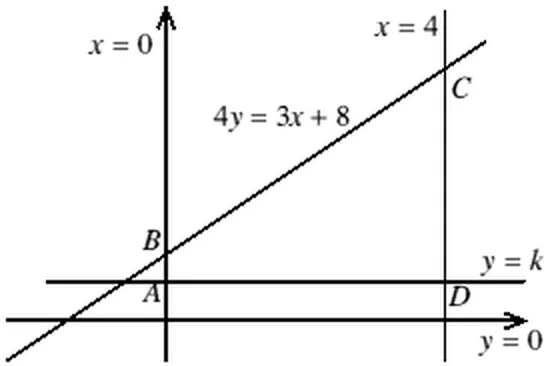
17. A trapezium is bounded by four lines, the equations of which are \(x = 0\), \(x = 4\), \(4y = 3x + 8\) and \(y = k\), where \(k < 2\).
For which value of \(k\) is the numerical value of the perimeter of the trapezium equal to the numerical value of the area of the trapezium?
- A \(\tfrac{3}{2}\)
- B 1
- C \(\tfrac{1}{2}\)
- D \(-\tfrac{1}{2}\)
- E −1
Senior Mathematical Challenge 2006, Question 17. © UK Mathematics Trust. Original paper on ukmt.org.uk
Answer: E −1
The trapezium in question is shown as \(ABCD\) in the diagram. The coordinates of its vertices are \(A(0,\ k)\), \(B(0,\ 2)\), \(C(4,\ 5)\), \(D(4,\ k)\). Using Pythagoras' Theorem: \(BC = \sqrt{4^2 + 3^2} = 5\).
The perimeter of \(ABCD = (2 - k) + 5 + (5 - k) + 4\)
\(= 16 - 2k\).
The area of \(ABCD = 4(2 - k) + \tfrac{1}{2} \times 4 \times 3\)
\(= 14 - 4k\). So \(16 - 2k = 14 - 4k\), that is \(k = -1\).
(In the diagram it was assumed that \(k > 0\), although it transpires that \(k < 0\). However, this does not affect the validity of the solution.)
Solution © UK Mathematics Trust, from the SMC 2006 solutions.