
SMC 2016 Q6
6. The diagram shows a square \(ABCD\) and a right-angled triangle \(ABE\). The length of \(BC\) is 3. The length of \(BE\) is 4.
What is the area of the shaded region?
- A \(5\frac{1}{4}\)
- B \(5\frac{3}{8}\)
- C \(5\frac{1}{2}\)
- D \(5\frac{5}{8}\)
- E \(5\frac{3}{4}\)
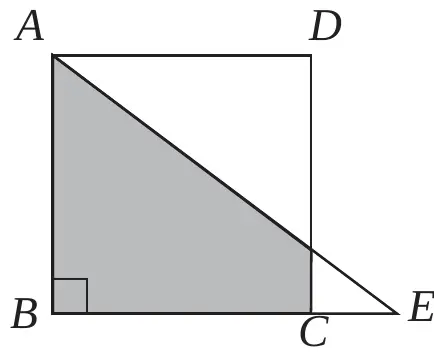
Senior Mathematical Challenge 2016, Question 6. © UK Mathematics Trust. Original paper on ukmt.org.uk
Answer: D \(5\frac{5}{8}\)
Let \(F\) be the point of intersection of the lines \(AE\) and \(CD\). Let the length of \(CF\) be \(h\). Then, using similar triangles, \(\dfrac{CF}{CE} = \dfrac{BA}{BE}\), so \(\dfrac{h}{1} = \dfrac{3}{4}\) giving \(h = \dfrac{3}{4}\). The shaded region \(ABCF\) is a trapezium, so has area \(\dfrac{1}{2}\left(3 + \dfrac{3}{4}\right) \times 3 = \dfrac{45}{8}\) which is \(5\frac{5}{8}\).
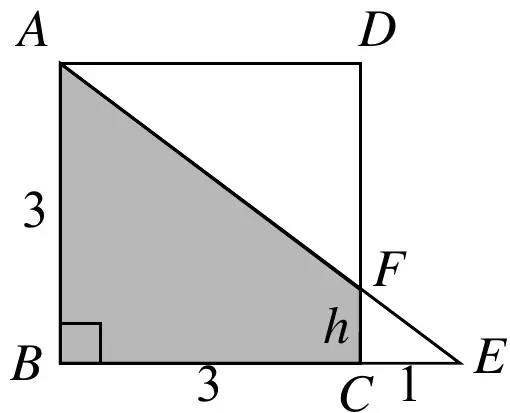
Solution © UK Mathematics Trust, from the SMC 2016 solutions. Longer versions with investigations: Solutions and investigations (PDF).