
IMC 2020 Q25
25. The diagram shows six points \(P\), \(Q\), \(R\), \(S\), \(T\) and \(U\) equally spaced around a circle of radius 2 cm. The inner circle has radius 1 cm. The shaded region has three lines of symmetry.
Which of the following gives the area, in cm2, of the shaded region?
- A \(2\pi + 3\)
- B \(3\pi + 2\)
- C \(\dfrac{4\pi + 3}{2}\)
- D \(3(\pi + 2)\)
- E \(4\pi + 3\)
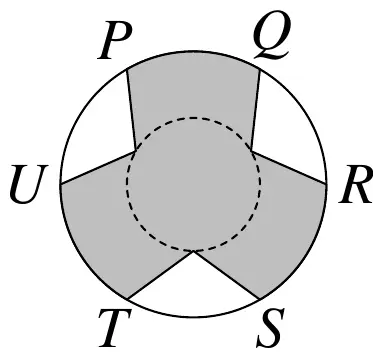
Intermediate Mathematical Challenge 2020, Question 25. © UK Mathematics Trust. Original paper on ukmt.org.uk
Answer: A \(2\pi + 3\)
The diagram shows exactly one third of the shaded area in the original diagram. It is made up of the quadrilateral \(UOPX\), together with a sector of the outer circle, \(POQ\), where \(O\) is the centre of the original circle.
Since \(P\) and \(Q\) are two of the six points equally spaced around the circle, \(\angle POQ = \tfrac{1}{6} \times 360° = 60°\). The outer circle has radius 2 cm, so the area, in cm2, of sector \(POQ\) is \(\tfrac{1}{6} \times \pi \times 2^2 = \tfrac{2\pi}{3}\).
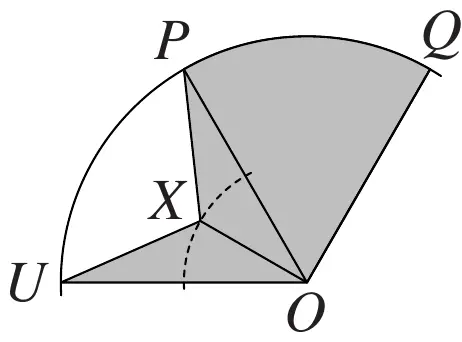
Since \(U\) and \(P\) are also equally spaced, \(\angle UOP = 60°\). So \(\angle UOX = 30°\).
Hence the area of triangle \(UOX\), in cm2, is \(\tfrac{1}{2} \times 1 \times 2 \times \sin 30° = \tfrac{1}{2}\).
So the area of quadrilateral \(UOPX\) is 1 cm2.
Therefore the total shaded area, in cm2, in the original diagram is \(3 \times (\tfrac{2\pi}{3} + 1) = 2\pi + 3\).
Solution © UK Mathematics Trust, from the IMC 2020 solutions. Longer versions with investigations: Solutions and investigations (PDF).