
IMC 2020 Q21
21. The diagram shows four semicircles, one with radius 2 cm, touching the other three, which have radius 1 cm.
What is the total area, in cm2, of the shaded regions?
- A 1
- B \(\pi - 2\)
- C \(2\pi - 5\)
- D \(\tfrac{3}{2}\)
- E \(\tfrac{1}{2}\pi\)
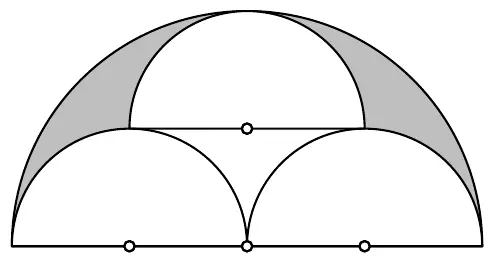
Intermediate Mathematical Challenge 2020, Question 21. © UK Mathematics Trust. Original paper on ukmt.org.uk
Answer: B \(\pi - 2\)
In the diagram, \(SR\) is the diameter of the upper small semicircle and \(P\) and \(Q\) are the centres of the two lower small semicircles.
Note that the line \(SR\) touches the two semicircles with centres \(P\) and \(Q\) at points \(S\) and \(R\) respectively.
So \(\angle SRQ = \angle RSP = 90°\).
Also, \(SR = PQ = 2\) cm. Therefore \(PQRS\) is a rectangle.
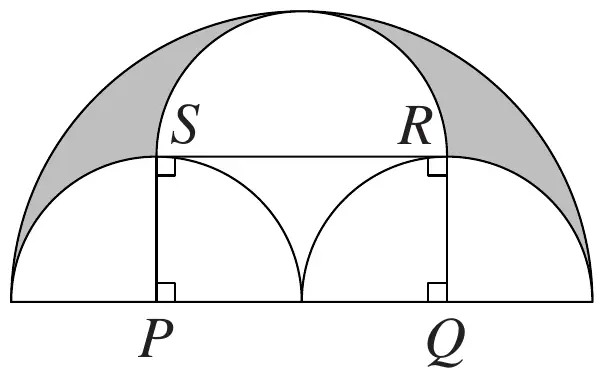
The total unshaded area in the diagram is the rectangle plus a semicircle and two quarter circles, that is, the rectangle plus a circle. So, in cm2, it is \(1 \times 2 + \pi \times 1^2 = 2 + \pi\).
So the total shaded area, in cm2, is \(\tfrac{1}{2} \times \pi \times 2^2 - (2 + \pi) = 2\pi - (\pi + 2) = \pi - 2\).
Hence the required area, in cm2, is \(\pi - 2\).
Solution © UK Mathematics Trust, from the IMC 2020 solutions. Longer versions with investigations: Solutions and investigations (PDF).