
IMC 2019 Q25
25. The diagram shows three touching semicircles with radius 1 inside an equilateral triangle, which each semicircle also touches. The diameter of each semicircle lies along a side of the triangle.
What is the length of each side of the equilateral triangle?
- A 3
- B \(\dfrac{13}{4}\)
- C \(\tfrac{3}{2}\sqrt{3}\)
- D \(2\sqrt{3}\)
- E 4
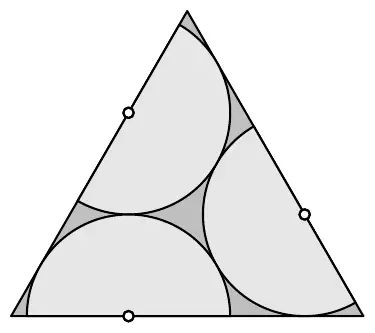
Intermediate Mathematical Challenge 2019, Question 25. © UK Mathematics Trust. Original paper on ukmt.org.uk
Answer: D \(2\sqrt{3}\)
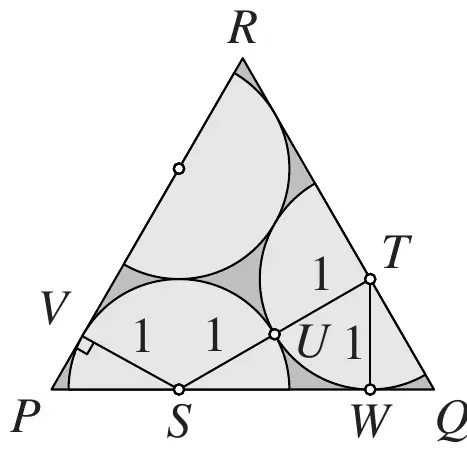
In the diagram, \(P\), \(Q\) and \(R\) are the vertices of the triangle; \(S\) and \(T\) are both centres of a semicircle; \(U\) is a point where two semicircles touch and \(V\) and \(W\) are points where a semicircle touches the triangle. So angles \(PVS\) and \(TWS\) are right angles, since a tangent to a circle is perpendicular to the radius of that circle at the point of contact. Also, the line joining the centres of two touching semicircles passes through their point of contact, so \(SUT\) is a straight line and has length 2. Note that \(\angle VPS = 60°\), and so \(\angle PSV = 30°\).
Note also that \(ST = 2\), \(TW = 1\) and \(\angle TWS\) is a right angle.
Therefore \(\sin \angle WST = \dfrac{1}{2}\) and so \(\angle WST = 30°\). However \(\angle TQS = 60°\) and so \(\angle STQ\) is a right angle.
From triangle \(SPV\), we see that \(\dfrac{SV}{PS} = \dfrac{1}{PS} = \sin 60° = \dfrac{\sqrt{3}}{2}\) and so
\(PS = \dfrac{2}{\sqrt{3}}\). Similarly, from triangle \(SQT\), we see that \(SQ = \dfrac{4}{\sqrt{3}}\).
Therefore \(PQ = \dfrac{6}{\sqrt{3}} = \dfrac{6\sqrt{3}}{3} = 2\sqrt{3}\).
Solution © UK Mathematics Trust, from the IMC 2019 solutions. Longer versions with investigations: Solutions and investigations (PDF).