
IMC 2019 Q15
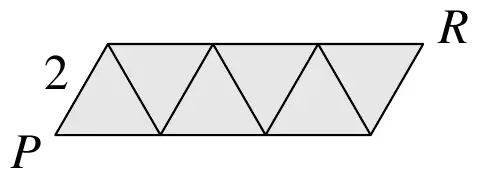
15. The diagram shows six congruent equilateral triangles, of side-length 2, placed together to form a parallelogram.
What is the length of \(PR\)?
- A \(2\sqrt{13}\)
- B 7
- C \(6\sqrt{3}\)
- D 9
- E \(7\sqrt{3}\)
Intermediate Mathematical Challenge 2019, Question 15. © UK Mathematics Trust. Original paper on ukmt.org.uk
Answer: A \(2\sqrt{13}\)
In the diagram shown, \(T\) is the foot of the perpendicular from \(R\) to \(PQ\) produced. Consider triangle \(QTR\). Angle \(QTR = 90°\) and, because the sum of angles on a straight line = 180°, angle \(RQT = (180 - 2 \times 60)° = 60°\). So \(\sin 60° = \dfrac{RT}{QR}\) and hence
\(RT = QR \times \sin 60° = 2 \times \dfrac{\sqrt{3}}{2} = \sqrt{3}\). Also \(\cos 60° = \dfrac{QT}{QR}\), so
\(QT = QR \times \cos 60° = 2 \times \tfrac{1}{2} = 1\). Therefore \(PT = 7\).
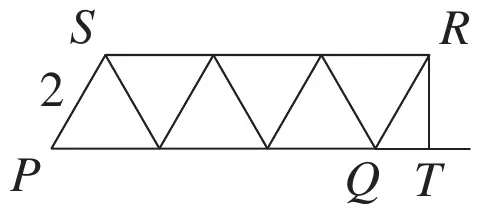
By Pythagoras’ Theorem, \(PR^2 = PT^2 + TR^2 = 7^2 + (\sqrt{3})^2\)
\(= 49 + 3 = 52\). So \(PR = \sqrt{52} = \sqrt{4} \times \sqrt{13} = 2\sqrt{13}\).
Solution © UK Mathematics Trust, from the IMC 2019 solutions. Longer versions with investigations: Solutions and investigations (PDF).