
IMC 2018 Q23
23. The diagram shows a hexagon. All the interior angles of the hexagon are 120°. The lengths of some of the sides are indicated.
What is the area of the hexagon?
- A \(20\sqrt{3}\)
- B \(21\sqrt{3}\)
- C \(22\sqrt{3}\)
- D \(23\sqrt{3}\)
- E \(24\sqrt{3}\)
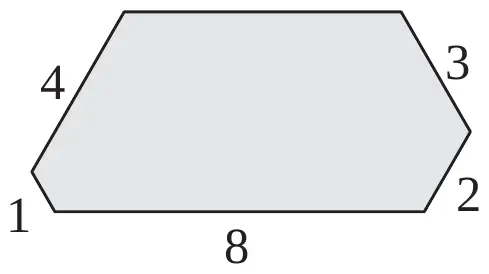
Intermediate Mathematical Challenge 2018, Question 23. © UK Mathematics Trust. Original paper on ukmt.org.uk
Answer: A \(20\sqrt{3}\)
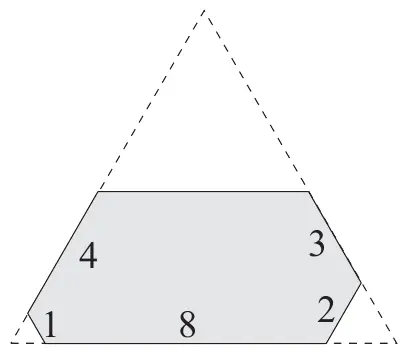
The diagram shows that the hexagon is an equilateral triangle of side 11 which has an equilateral triangle of side 1 removed from the bottom left corner, an equilateral triangle of side 2 removed from the bottom right corner and an equilateral triangle of side 6 removed from the top.
Using the formula \(\Delta = \tfrac{1}{2}ab \sin C\) for the area of a triangle, the area of an equilateral triangle of side \(l\) is
\(\dfrac{1}{2} \times l \times l \times \sin 60° = \dfrac{1}{2} \times l^2 \times \dfrac{\sqrt{3}}{2} = \dfrac{\sqrt{3}}{4}l^2\). So the area of the hexagon is
\(\dfrac{\sqrt{3}}{4}\left(11^2 - 6^2 - 1^2 - 2^2\right) = \dfrac{\sqrt{3}}{4}(121 - 36 - 1 - 4) = \dfrac{\sqrt{3}}{4} \times 80 = 20\sqrt{3}\).
Solution © UK Mathematics Trust, from the IMC 2018 solutions. Longer versions with investigations: Solutions and investigations (PDF).