
IMC 2017 Q20
20. The diagram shows seven circular arcs and a heptagon with equal sides but unequal angles. The sides of the heptagon have length 4. The centre of each arc is a vertex of the heptagon, and the ends of the arc are the midpoints of the two adjacent sides.
What is the total shaded area?
- A \(12\pi\)
- B \(14\pi\)
- C \(16\pi\)
- D \(18\pi\)
- E \(20\pi\)
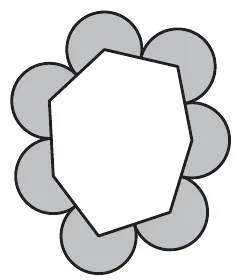
Intermediate Mathematical Challenge 2017, Question 20. © UK Mathematics Trust. Original paper on ukmt.org.uk
Answer: D \(18\pi\)
First note that as the length of each side of the heptagon is 4, the radius of each of the seven arcs is 2. The sum of the interior angles of a heptagon is (7 − 2) × 180° = 900°. So the sum of the angles subtended by the circular arcs at the centres of the circles of radius 2 cm is 7 × 360° − 900° = \((7 - \frac{5}{2}) \times 360\)° = \(\frac{9}{2} \times 360\)°. Therefore the total shaded area is equal to the total area of \(\frac{9}{2}\) circles of radius 2. So the total shaded area is \(\frac{9}{2} \times \pi \times 2^2 = 18\pi\).
Solution © UK Mathematics Trust, from the IMC 2017 solutions. Longer versions with investigations: Solutions and investigations (PDF).