
IMC 2016 Q25
25. The tiling pattern shown uses two types of tile, regular hexagons and equilateral triangles, with the length of each side of the equilateral triangles equal to half the length of each side of the hexagons. A large number of tiles is used to cover a floor.
Which of the following is closest to the fraction of the floor that is shaded black?
- A \(\dfrac{1}{8}\)
- B \(\dfrac{1}{10}\)
- C \(\dfrac{1}{12}\)
- D \(\dfrac{1}{13}\)
- E \(\dfrac{1}{16}\)
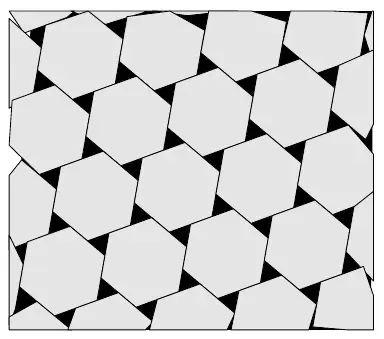
Intermediate Mathematical Challenge 2016, Question 25. © UK Mathematics Trust. Original paper on ukmt.org.uk
Answer: D \(\dfrac{1}{13}\)
The tiled area may be considered to be a tessellation of the figure shown, except for the dotted lines. For every hexagonal tile, there are two triangular tiles. The diagram shows that the area of each hexagonal tile is 24 times the area of each triangular tile. As there are two triangular tiles to each hexagonal tile, the ratio of the fraction of the floor shaded black to that which is shaded grey is 2 : 24 = 1: 12. Therefore, in the repeating pattern of tiles, the fraction which is shaded black is 1/13.
The exact ratios given are for the infinite plane. Since we are dealing with a finite floor, this is approximate since the edges are unpredictable, but close to correct since the numbers involved are large.
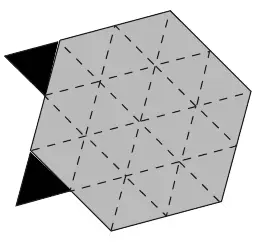
Solution © UK Mathematics Trust, from the IMC 2016 solutions. Longer versions with investigations: Solutions and investigations (PDF).