
IMC 2016 Q15
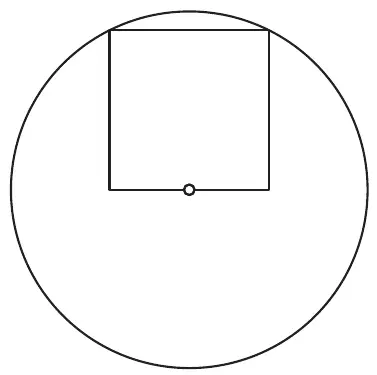
15. The circle has radius 1 cm. Two vertices of the square lie on the circle. One edge of the square goes through the centre of the circle, as shown.
What is the area of the square?
- A \(\dfrac{4}{5}\) cm2
- B \(\dfrac{\pi}{5}\) cm2
- C 1 cm2
- D \(\dfrac{\pi}{4}\) cm2
- E \(\dfrac{5}{4}\) cm2
Intermediate Mathematical Challenge 2016, Question 15. © UK Mathematics Trust. Original paper on ukmt.org.uk
Answer: A \(\dfrac{4}{5}\) cm2
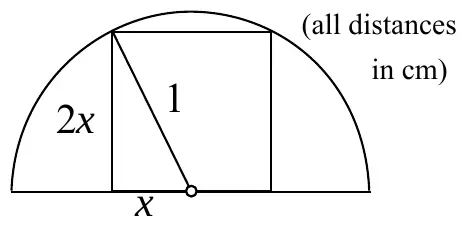
Let the length of the side of the square be \(2x\) cm. Then, using Pythagoras' Theorem in the triangle shown, \((2x)^2 + x^2 = 1^2\). So \(4x^2 + x^2 = 1\). Therefore \(x^2 = \frac{1}{5}\) and the area of the square is \(4x^2\) cm2 = \(\frac{4}{5}\) cm2.
Solution © UK Mathematics Trust, from the IMC 2016 solutions. Longer versions with investigations: Solutions and investigations (PDF).