
JMC 2018 Q24
24. The shapes P and Q are formed from two and three identical rectangles, respectively. Their perimeters are 58 cm and 85 cm respectively.
What is the perimeter of one of the rectangles?
- A 30 cm
- B 31 cm
- C 32 cm
- D 33 cm
- E 34 cm
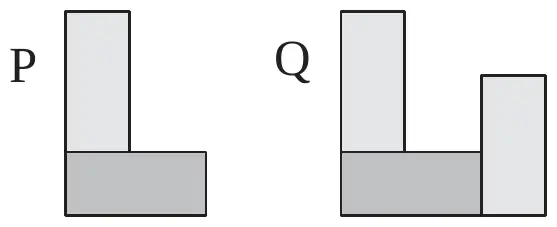
Junior Mathematical Challenge 2018, Question 24. © UK Mathematics Trust. Original paper on ukmt.org.uk
Answer: B 31 cm
Let the perimeter of one of the rectangles be \(p\) cm and let the length of one of its shorter sides be \(x\) cm. Before the rectangles in figure \(P\) are joined together, their total perimeter is \(2p\) cm. However, when they are joined together, a length equal to the lengths of two of the shorter sides is ‘lost’ at the join. So the perimeter of shape \(P\), in cm, equals \(2p - 2x\). So \(2p - 2x = 58\)… (1). Similarly, shape \(Q\) consists of three of the rectangles, but there are two joins. So a length equal to the lengths of four of the shorter sides is ‘lost’ at the joins. Therefore, the perimeter of shape \(Q\), in cm, equals \(3p - 4x\). So \(3p - 4x = 85\)… (2). Multiplying equation (1) by 2 and then subtracting equation (2) gives \(4p - 4x - (3p - 4x) = 2 \times 58 - 85\). So \(p = 31\). Therefore the perimeter of one of the rectangles is 31 cm.
Solution © UK Mathematics Trust, from the JMC 2018 solutions. Longer versions with investigations: Solutions and investigations (PDF).