
JMC 2019 Q24
24. The diagram shows a regular heptagon.
Which of these expressions is equal to \(p + q + r + s + t\)?
- A \(180 + q\)
- B \(180 + 2q\)
- C \(360 - q\)
- D 360
- E \(360 + q\)
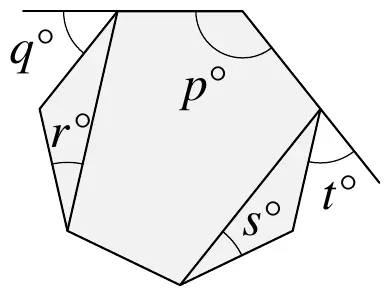
Junior Mathematical Challenge 2019, Question 24. © UK Mathematics Trust. Original paper on ukmt.org.uk
Answer: B \(180 + 2q\)
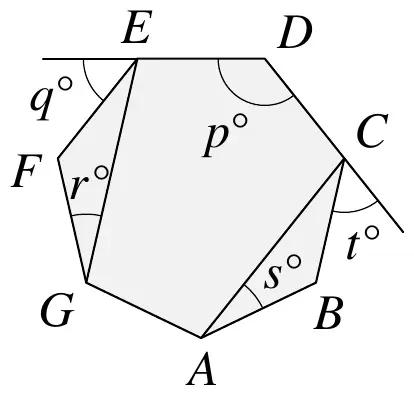
Consider triangles \(GFE\) and \(ABC\). Both triangles have two sides which are sides of the regular heptagon, so \(GF = FE = AB = BC\). Also, angles \(GFE\) and \(ABC\) are equal as both are interior angles of the regular heptagon. So the two triangles are isosceles and congruent (SAS). Therefore \(\angle FEG = \angle BCA\) as the two triangles are congruent and \(\angle BCA = \angle BAC\) as triangle \(ABC\) is isosceles. So \(\angle FEG = s°\).
Also, \(\angle GFE = \angle EDC = p°\) as both angles are interior angles of the regular heptagon. Hence in triangle \(GFE\), as the sum of the interior angles of a triangle is 180°, \(p + r + s = 180\).
Finally, exterior angles of a regular heptagon are equal and therefore \(q = t\). So \(p + q + r + s + t = 180 + q + t = 180 + 2q\).
Since \(q°\) is the size of the exterior angle of the regular heptagon, \(q = \tfrac{360}{7}\).
So it is clear that none of the other options equals \(180 + 2q\).
(Note that this result does not apply only to a regular heptagon. The above calculation would be the same for every regular polygon with at least five sides.)
Solution © UK Mathematics Trust, from the JMC 2019 solutions. Longer versions with investigations: Solutions and investigations (PDF).