
JMC 2019 Q11
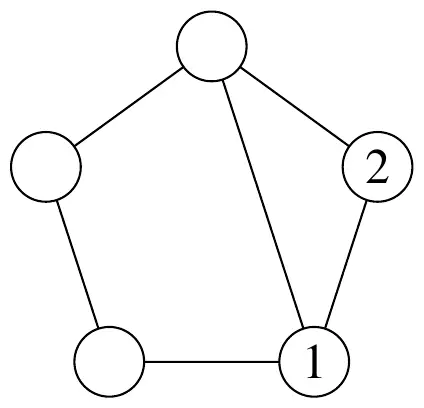
11. Two players \(X\) and \(Y\) take alternate turns in a game, starting with the diagram alongside.
At each turn, one player writes one of 1, 2 or 3 in an empty circle, so that no two circles connected by an edge contain the same number. A player loses when they cannot go. In each of the five diagrams below it is \(Y\)’s turn.
In which of the diagrams can \(Y\)’s move ensure that \(X\) loses the game?

Junior Mathematical Challenge 2019, Question 11. © UK Mathematics Trust. Original paper on ukmt.org.uk
Answer: D
Note that in each of the figures, there will be exactly one empty circle available after \(Y\) takes the next turn. So for \(Y\) to ensure that there is a definite loss for \(X\), then the latter must be left in a situation where the only available circle is already connected to each of 1, 2 and 3. It is left to the reader to show that \(Y\) cannot ensure a loss for \(X\) in figures A, B, C and E. However, if \(Y\) places 3 in the available circle on the left of figure D, then \(X\) is left with the top circle which is now connected to 1, 2 and 3. Hence \(X\) loses.
Solution © UK Mathematics Trust, from the JMC 2019 solutions. Longer versions with investigations: Solutions and investigations (PDF).