
Numeracy Higher June 2017 Unit 1 Q11
11. The diagram below shows a wooden end-piece for a curtain pole.
It is in the shape of a cone with measurements as shown in the diagram.
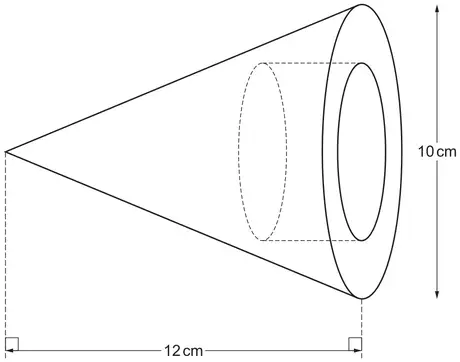
Diagram not drawn to scale
The curtain pole sits in a cylindrical hole that has been drilled into the end-piece.
The hole is of radius 3 cm and depth 4 cm.
From the formula list: Volume of cone \(= \dfrac{1}{3}\pi r^2 h\); Curved surface area of cone \(= \pi r l\)
(a) Show that the volume of wood that remains is 64\(\pi\) cm3. [4]
(b) The surface area of the end-piece is to be painted, except for the area inside the hole.
Calculate the surface area that is to be painted.
Give your answer in terms of \(\pi\). [6]
Calculate the surface area that is to be painted.
Give your answer in terms of \(\pi\). [6]
| Scheme | Marks | Comments |
|---|---|---|
| Allow the use of numerical values of pi for the B2 and M1 marks | ||
| ⅓×\(\pi\)×52×12 and \(\pi\)×32×4 | B2 | B1 for either of these expressions |
| (Vol remaining =) ⅓×\(\pi\)×52×12 − \(\pi\)×32×4 | M1 | FT use of ⅓×\(\pi\)×102×12 |
| = 100\(\pi\) − 36\(\pi\) (= 64\(\pi\) cm3) | A1 | Convincing. Must be in terms of \(\pi\). |
| Scheme | Marks | Comments |
|---|---|---|
| (Slant length2 =) 122 + 52 | M1 | |
| Slant length2 = 169 OR (Slant length =) √169 | A1 | |
| (Slant length =) 13 (cm) | A1 | May be unsupported |
| (Surface area =) \(\pi\)×52 – \(\pi\)×32 + \(\pi\)×5×13 | M2 | Allow the use of numerical values of pi FT ‘their 13’ provided Pythagoras attempted M1 for the appropriate addition/subtraction of 2 correct terms |
| = 81\(\pi\) (cm2) | A1 | CAO. Must be in terms of \(\pi\). |