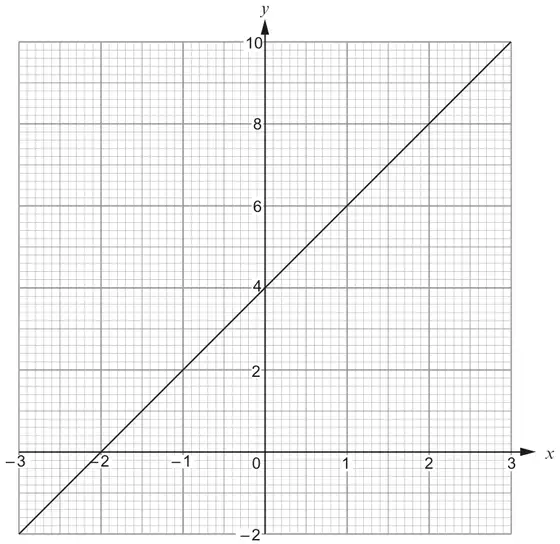
(a) The diagram below shows the graph of a straight line for values of \(x\) from −3 to 3.
(i) Write down the gradient of the above line. [1]
(ii) Write down the equation of the line in the form \(y = mx + c\), where \(m\) and \(c\) are whole numbers. [2]
(b) Without drawing, show that the line \(2y = 5x - 3\) is parallel to the line \(4y = 10x + 7\). You must show working to support your answer. [2]
Mark scheme (a)
Scheme
Marks
Comments
Ribbon marking for 15(a)(i) and 15(a)(ii). (i) 2
B1
Accept 12/6 or equivalent. The correct gradient has to be unambiguously shown. y = 2x + 4 is B0. Allow e.g. y = 2x + 4 for B1.
Ribbon marking for 15(a)(i) and 15(a)(ii). (ii) y = 2x + 4
B2
F.T. ‘their gradient’ from (a) only if a whole number. B1 for y = 2x ± k. B1 for y = kx + 4. B1 for 2x +4 (‘y=’ missing)
Mark scheme (b)
Scheme
Marks
Comments
(Both have) equal gradients of 2·5.
B2
Accept equivalent of 2·5. Accept y = 2·5x – 1·5 AND y = 2·5x + 1·75 for B2 unless a contradiction is seen.
B1 for stating ‘equal gradients’ but not given as 2·5. B1 for sight of 2·5, or equivalent, but no mention of gradient. Also Correctly rewriting the equation(s) such that they show equal corresponding x and y coefficients, e.g. 2y = 5x – 3 and 2y = 5x + 3·5 gains a B1. In this case they need to make a further statement to show an understanding of gradients to gain 2nd B1.
We'd like to use Google Analytics cookies to count visits and see which pages help most. They're optional, and the site works exactly the same either way. Privacy policy