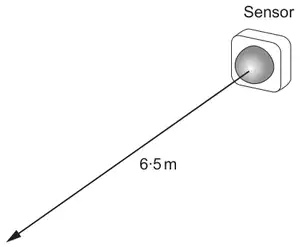
11. A sensor can detect any movement up to a distance of 6·5 m.
Diagram not drawn to scale
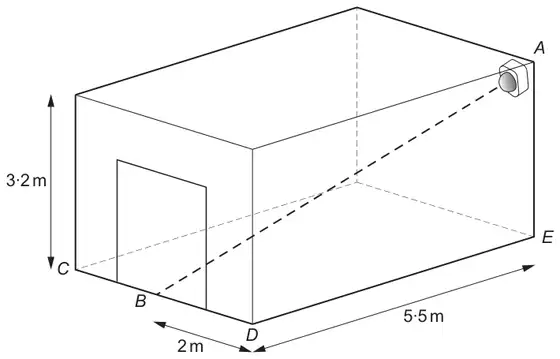
(a) A storeroom is in the shape of a cuboid, as shown below. The sensor is placed at A, so that
it is aimed directly at B, where BD = 2 m,
the front of the sensor is 20 cm from A along the line AB.
Diagram not drawn to scale
Will the sensor be able to detect movement at B? You must show all your working. [5]
(b) Show that \(B\hat{A}E\) = 61·3°, correct to 1 decimal place. [3]
Mark scheme (a)
Scheme
Marks
Comments
(BE2 =) 22 + 5·52 BE2 = 34·25 or (BE =) √34·25 or (BE =) 5·8(5…)
M1 A1
(AB2 =) 34·25 + 3·22 or 5·8(5…)2 + 3·22
M1
FT ‘their derived BE’
(AB =) 6·67(00..) (m)
A1
Accept an answer that would round to 6·67 (m) Accept an answer of 6·7 (m) provided √44·42(...) to √44·55(...) seen in workings
Alternative method: M1 for (AD2 =) 3·22 + 5·52 A1 for AD2 = 40·49 or (AD =) √40·49 or (AD =) 6·3(6…) M1 for (AB2 =) 40·49 + 22 or 6·3(6…)2 + 22 FT ‘their derived AD’ A1 for (AB =) 6·67(00..) (m) Accept an answer that would round to 6·67 (m) Accept an answer of 6·7 (m) provided √44·42(...) to √44·55(...) seen in workings
(Dist = 6·67(00..) – 0·2 =) 6·47(00..) (m) AND e.g. ‘Yes, it will detect movement at B’
E1
FT correct interpretation of ‘their 6·67(00..)’ – 0.2 provided M1M1 awarded Allow ‘Yes as distance < 6.5 (m)’
Mark scheme (b)
Scheme
Marks
Comments
(BÂE =) cos-1(3.2 ÷ 6·67(00..) or tan−1 (5·8(523…) ÷ 3·2) or sin-1 (5·8(523…) ÷ 6·67(00..))
M2
M1 for cos (BÂE) = (3.2 ÷ 6·67(00…) or tan (BÂE) = (5·8(523..) ÷ 3·2) or sin (BÂE) = (5·8(523..) ÷ 6·67(00..)) FT “their derived 5·8(523..) and 'their derived 6·67(00…)’ Do not allow use of 20 for ‘their 6·67(00…)’
(BÂE =) 61·3(306…) (°)
A1
CAO Accept an answer that rounds to 61·3(°)
Alternative method: M2 for cos-1\(\dfrac{6{\cdot}67(...)^{2} + 3{\cdot}2^{2} - 5{\cdot}8(5\ldots)^{2}}{2 \times 6{\cdot}67(...) \times 3{\cdot}2}\) M1 for cos(angle) = \(\dfrac{6{\cdot}67(...)^{2} + 3{\cdot}2^{2} - 5{\cdot}8(5\ldots)^{2}}{2 \times 6{\cdot}67(...) \times 3{\cdot}2}\) FT “their derived 5·8(523..) and 'their derived 6·67(00…)’ Do not allow use of 20 for ‘their 6·67(00…)’
A1 for (BÂE =) 61·3(306…) (°) CAO Accept an answer that rounds to 61·3(°)
We'd like to use Google Analytics cookies to count visits and see which pages help most. They're optional, and the site works exactly the same either way. Privacy policy