
Higher November 2018 Unit 1 Q14
14. In the diagram below, \(AC\) and \(BD\) are diameters of a circle, centre \(O\).
\(AO = 30\) cm and \(A\hat{O}B = 20^\circ\).
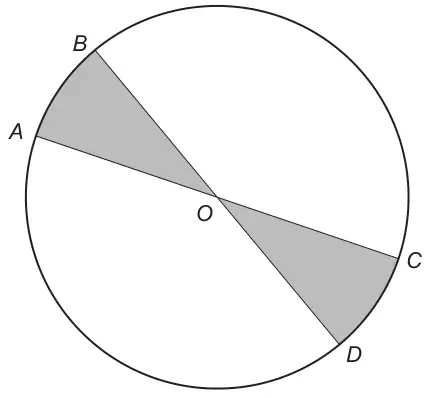
Diagram not drawn to scale
A second circle has an area which equals the total shaded area above.
Calculate the radius of the second circle. [3]
| Scheme | Marks | Comments |
|---|---|---|
| (Total area =) (2 ×) \(\pi \times 30^2 \times 20/360\) or equivalent (= \(100\pi\)) | M1 | Accept use of 3·14 for \(\pi\). |
| \(100\pi = \pi r^2\) | m1 | Equating 'their derived \(100\pi\)' or equivalent |
| \(r = 10\) (cm) | A1 | CAO |