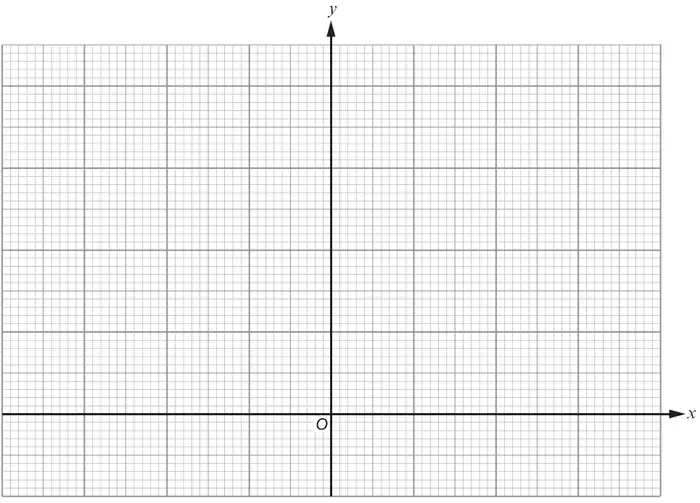
(a) Draw the graph of the curve \(y = 2^x\) for values of \(x\) from –2 to 2. Use the graph paper below. [3]
(b) Use your graph to find the value of \(2^{1{\cdot}4}\). [1]
(c) Use your graph to solve the equation \(2^x = 1{\cdot}4\). [1]
Mark scheme (a)
Scheme
Marks
Comments
\(x\)
–2
–1
0
1
2
\(y\)
\(\frac{1}{4}\)
\(\frac{1}{2}\)
1
2
4
B1
Any 3 correct pairs of coordinates (need not be for integer values of x.) Must include one negative value of x.
Suitable choice of uniform scales through the origin, \(x\) from – 2 to 2 and \(y\) from 0 to 4, AND plotting at least 3 points correctly.
B1
FT their evaluations of \(y\) if shown (provided they do not produce a straight line). Must include one negative value of x. Tolerance for accuracy ± \(\frac{1}{2}\) a small square.
Joining with a curve.
C1
CAO. Exponential curve which passes through (-2, \(\frac{1}{4}\)), (0, 1) and (2, 4). Must not intercept x axis anywhere, including beyond the required range of x values. Tolerance for accuracy ± \(\frac{1}{2}\) a small square.
If no table or evaluations of coordinates are given (for at least 3 pairs of values, including one negative value of x), then B1 B1 may be implied by C1 or if C0, B1 B1 may be implied by 3 correctly plotted points for y = 2x (including one negative value of x).
Mark scheme (b)
Scheme
Marks
Comments
Reading from their graph for \(x = 1{\cdot}4\) \((y \approx 2{\cdot}6)\)
B1
FT ‘their curve’. (No FT for a straight line.) Tolerance for accuracy ± \(\frac{1}{2}\) a small square.
Mark scheme (c)
Scheme
Marks
Comments
Reading from their graph for \(y = 1{\cdot}4\) \((x \approx 0{\cdot}5)\)
B1
Accept an embedded answer. FT ‘their curve’. (No FT for a straight line.) Must include all relevant readings if ‘their graph’ is not one-to-one. Tolerance for accuracy ± \(\frac{1}{2}\) a small square.
We'd like to use Google Analytics cookies to count visits and see which pages help most. They're optional, and the site works exactly the same either way. Privacy policy