
Higher June 2022 Unit 2 Q5
5.
(a) Factorise \(8x^2 + 6xy\). [2]
(b)
(i) Factorise \(x^2 + 13x + 40\). [2]
(ii) Explain how you can check that your answer to part (i) is correct. [1]
| Scheme | Marks | Comments |
|---|---|---|
| \(2x(4x + 3y)\) | B2 | Award B1 for \(2x(4x \pm\)……..) or \(2x(\)…….\(+\, 3y)\) Award B1 for a partial factorisation. i.e. \(2(4x^2 + 3xy)\) or \(x(8x + 6y)\). Mark final answer. |
(b)(i)
| Scheme | Marks | Comments |
|---|---|---|
| \((x + 8)(x + 5)\) ISW | B2 | B1 for \((x \ldots 8)(x \ldots 5)\). |
(b)(ii)
| Scheme | Marks | Comments |
|---|---|---|
| Any valid explanation e.g. “you could expand the two brackets” “expanding is the opposite of factorising” “multiply the brackets together” “solve \((x + 8)(x + 5) = 0\), and then substitute the value(s) of \(x\) into \(x^2 + 13x + 40\). It should give 0.” “replace \(x\) in the brackets and expression with the same value. You should get the same answer.” | E1 | Allow “the two numbers need to add to 13, but multiply to make 40” “Use FOIL (CAMO) to check” or other names explaining the method. Allow method shown to expand brackets for example: 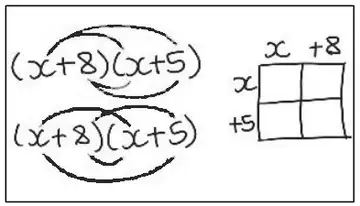 “\((x + 8)(x + 5) = x^2 + 13x + 40\)” without further working “taking out the brackets” "reverse the calculation" |