
Higher June 2025 Unit 2 Q6
6. In the diagram below, the triangles \(ABC\) and \(DBE\) are mathematically similar.
\(CB\) = 8 cm, \(DB\) = 7·5 cm, \(BE\) = 5 cm and \(A\hat{C}B = D\hat{E}B\).
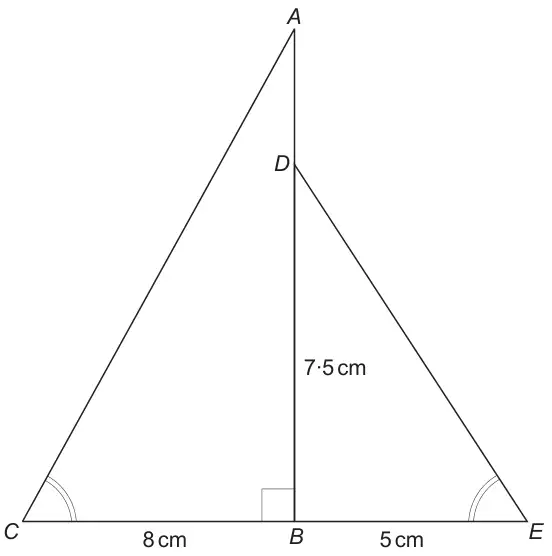
Diagram not drawn to scale
Calculate the length of \(AB\). [2]
| Scheme | Marks | Comments |
|---|---|---|
| (\(AB\) = ) 7·5 × \(\dfrac{8}{5}\) or \(\dfrac{AB}{7.5} = \dfrac{8}{5}\) or equivalent OR (\(AB\) = ) 7·5 ÷ \(\dfrac{5}{8}\) or \(\dfrac{7.5}{5} = \dfrac{AB}{8}\) | M1 | Check diagram for answer. May be seen in stages. M1 for correct use of scale factor (e.g \(\dfrac{8}{5}\) or \(\dfrac{5}{8}\) or equivalent). |
| 12 (cm) | A1 | Mark final answer. An unsupported answer of 12 is awarded M1A1. |
6. Alternative method:
| Scheme | Marks | Comments |
|---|---|---|
| Correct use of ‘two-step’ method. | M1 | A partial trigonometric method is M0. |
| 12 (cm) | A1 | Mark final answer. Allow an answer in the range \(11{\cdot}99 \leqslant AB \lt 12{\cdot}01\) (cm). |
Corrected by Westie's Workshop
- The board's mark scheme printed “6.(b) Alternative method:”. Changed to “6. Alternative method:” because question 6 has no part (b); this alternative method is for question 6 as a whole.
Original: see the board's mark scheme PDF (link above).