
Higher June 2025 Unit 1 Q10
10. In the diagram below, ABCD and ABCE are cyclic quadrilaterals.
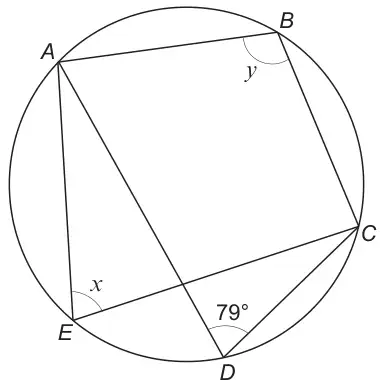
Diagram not drawn to scale
(a) Find the size of angle \(x\). [1]
(b) Calculate the size of angle \(y\).
State the circle theorem that you have used to find your answer. [2]
| Scheme | Marks | Comments |
|---|---|---|
| \(x = 79(^\circ)\) | B1 | Answer space takes precedence. If no answer given on answer space, check diagram for 79\(^\circ\) correctly placed. |
| Scheme | Marks | Comments |
|---|---|---|
| \((y = 180 - 79 =)\) \(101(^\circ)\) | B1 | Answer space takes precedence. If no answer given on answer space, check diagram for 101\(^\circ\) correctly placed. FT 180 – ‘their \(x\) from (a)’, provided \(x \neq 101\) or 90. |
| Opposite angles (of a) cyclic quadrilateral (add up to 180\(^\circ\)) | E1 | Although the words in brackets need not be seen, if additional words are added they must be correct e.g. Opposite angles of a cyclic quadrilateral are equal is awarded E0. |