
May 2026 Paper 1 Q12
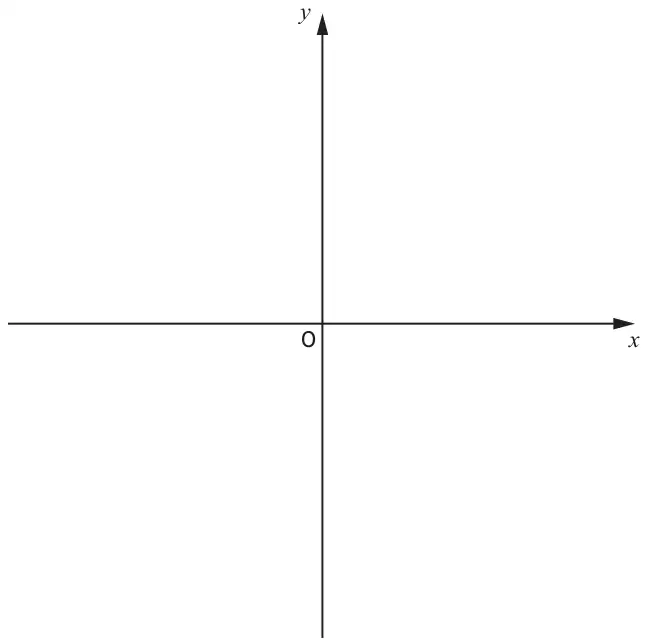
12. On the axes below, sketch the graph of \(y=(x+2)^2+3\).
On your sketch, show clearly the coordinates of the turning point and the point of intersection with the \(y\)-axis. [3]
| Mark | Generic scheme | Illustrative scheme |
|---|---|---|
| Method 1 | Method 1 | |
| •1 | correct coordinates of turning point | \((-2, 3)\) |
| •2 | sketch parabola with minimum turning point consistent with •1 | 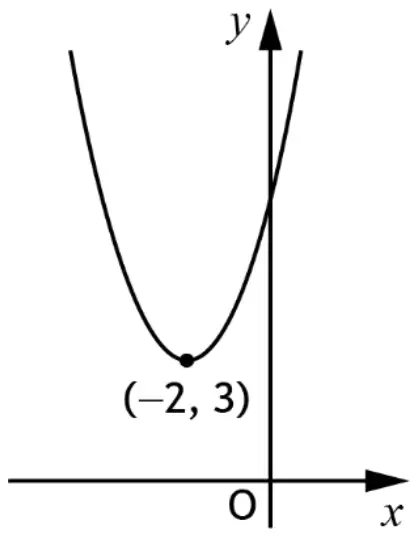 |
| •3 | correct \(y\)-intercept shown on sketch | 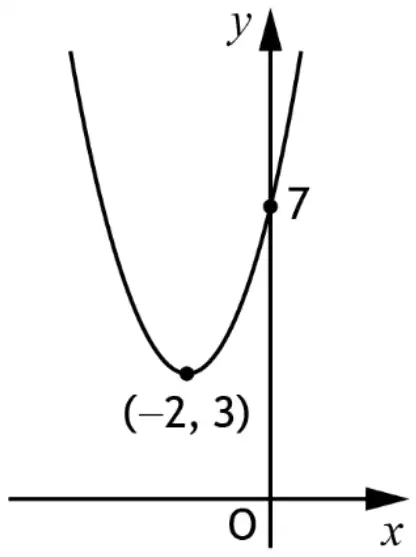 |
| Method 2 | Method 2 | |
| •1 | correct coordinates of turning point | \((-2, 3)\) |
| •2 | state correct \(y\)-intercept | \((0, 7)\) or 7 |
| •3 | sketch parabola with minimum turning point and \(y\)-intercept consistent with •1 and •2 | 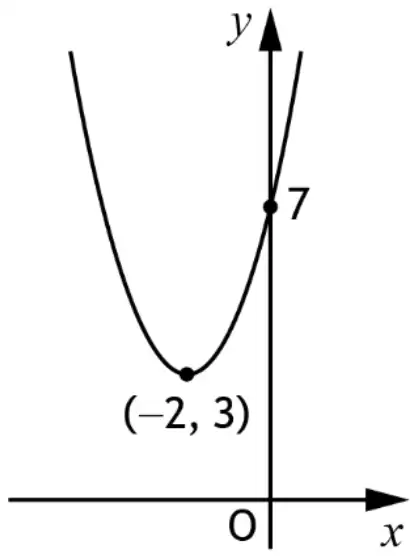 |
| (3) |
Notes:
- Correct answer without working. award 3/3
- Where the coordinates of the turning points are not stated elsewhere, then for a sketch of a parabola with minimum turning point \((-2,-3)\), \((2,\pm3)\) or \((\pm3,\pm2)\) •2 and •3 are still available.
Otherwise •3 is only available where the minimum turning point indicated on the sketch is consistent with that stated elsewhere. - In method 1, the sketch of the parabola need not meet or cut the \(y\)-axis for the award of •2.
- •3 is not available if the parabola has a maximum turning point.
- •3 is not available if the minimum turning point is on the \(y\)-axis.
- Award •3 where the \(y\)-intercept is calculated to be at \(y=7\) and is plotted on the diagram at \((0,7)\) but is annotated as \((7,0)\).
- •2 and •3 are not available if the turning point and the \(y\)-intercept have the same \(y\)-coordinate.
- •1 is available where a candidate sketches a parabola with a maximum turning point of \((-2,3)\) and the coordinates of the turning point are not stated elsewhere.