
May 2026 Paper 1 Q9
9.
(a) Show that the points D(−1,6,1), E(1,2,7) and F(2,0,10) are collinear. [3]
Point G is such that F divides DG in the ratio 3:4.
(b) Find the coordinates of G. [2]
| Mark | Generic scheme | Illustrative scheme |
|---|---|---|
| •1 | find an appropriate vector eg \(\overrightarrow{\text{DE}}\) | eg \(\overrightarrow{\text{DE}}=\begin{pmatrix}2\\-4\\6\end{pmatrix}\) |
| •2 | find a second vector eg \(\overrightarrow{\text{EF}}\) and compare | eg \(\overrightarrow{\text{EF}}=\begin{pmatrix}1\\-2\\3\end{pmatrix}\therefore\overrightarrow{\text{DE}}=2\overrightarrow{\text{EF}}\) |
| •3 | appropriate conclusion | \(\Rightarrow\) DE is parallel to EF (common direction) and E is a common point \(\Rightarrow\) D,E and F are collinear |
| (3) |
Notes:
- Do not penalise inconsistent vector notation (for example lack of arrows or brackets).
- The comparison at •2 may be expressed as a ratio, for example DE : EF = 2 : 1.
- If no comparison of vectors or the trivial comparison ‘\(\overrightarrow{\text{DE}}=\overrightarrow{\text{EF}}\)’ is made at •2, then •3 is not available.
- •3 can only be awarded if a candidate has stated ‘parallel’, ‘common point’ and ‘collinear’.
- Candidates who state or imply that ‘points are parallel’ or ‘vectors are collinear’ or state ‘parallel and share a common point \(\Rightarrow\)collinear’ do not gain •3. There must be reference to the points.
- Do not accept ‘\(d\), \(e\) and \(f\) are collinear’ at •3.
Commonly Observed Responses:
Candidate A - missing labels
| \(\begin{pmatrix}2\\-4\\6\end{pmatrix}\) | •1 ^ |
| \(\begin{pmatrix}1\\-2\\3\end{pmatrix}\therefore\overrightarrow{\text{DE}}=2\overrightarrow{\text{EF}}\) | •2 ✓1 |
| \(\Rightarrow\) DE is parallel to EF (common direction) and E is a common point \(\Rightarrow\) D,E and F are collinear | •3 ✓1 |
[Annotation in the marking instructions: callout on the second vector: “Missing labels treated as a repeated error”]
Candidate B
| \(\overrightarrow{\text{EF}}=\begin{pmatrix}1\\-2\\3\end{pmatrix}\) | •1 ✓ |
| \(\overrightarrow{\text{DE}}=\begin{pmatrix}2\\-4\\6\end{pmatrix}=2\begin{pmatrix}1\\-2\\3\end{pmatrix}\) | •2 ✓ |
| \(\therefore 2\overrightarrow{\text{DE}}=\overrightarrow{\text{EF}}\) | |
| \(\Rightarrow\) DE is parallel to EF (common direction) and E is a common point \(\Rightarrow\) D,E and F are collinear | •3 ✓ |
[Annotation in the marking instructions: callout on \(\therefore 2\overrightarrow{\text{DE}}=\overrightarrow{\text{EF}}\): “ignore working subsequent to correct statement on previous line”]
| Mark | Generic scheme | Illustrative scheme |
|---|---|---|
| Method 1 | Method 1 | |
| •4 | interpret ratio | \(\begin{pmatrix}3\\-6\\9\end{pmatrix}\) and \(\begin{pmatrix}4\\-8\\12\end{pmatrix}\) or \(\begin{pmatrix}7\\-14\\21\end{pmatrix}\) |
| •5 | find coordinates of G | \((6,-8,22)\) |
| Method 2 | Method 2 | |
| •4 | interpret ratio | eg \(\overrightarrow{\text{FG}}=\dfrac{4}{3}\overrightarrow{\text{DF}}\) or \(\overrightarrow{\text{DG}}=\dfrac{7}{3}\overrightarrow{\text{DF}}\) |
| •5 | find coordinates of G | \((6,-8,22)\) |
| Method 3 | Method 3 | |
| •4 | use section formula | \(\dfrac{1}{3}(-4\mathbf{d}+7\mathbf{f})\) or \(\mathbf{f}=\dfrac{3}{7}\mathbf{g}+\dfrac{4}{7}\mathbf{d}\) |
| •5 | find coordinates of G | \((6,-8,22)\) |
| (2) |
Notes:
- Do not penalise inconsistent vector notation (for example lack of arrows or brackets).
- For (6,−8,22) without working award 2/2.
- For \(\begin{pmatrix}6\\-8\\22\end{pmatrix}\) without working award 1/2.
- For \(\left(\dfrac{17}{4},-\dfrac{9}{2},\dfrac{67}{4}\right)\) (ratio of 4:3 with working) award 1/2. See Candidate C.
- No marks are available for finding an internal division point, for example \(\left(\dfrac{2}{7},\dfrac{24}{7},\dfrac{34}{7}\right)\) or using other ratios.
Commonly Observed Responses:
Candidate C - ratio of 4:3
| \(\overrightarrow{\text{FG}}=\dfrac{3}{4}\overrightarrow{\text{DF}}\) | •4 ✗ |
| \(\text{G}=\left(\dfrac{17}{4},-\dfrac{9}{2},\dfrac{67}{4}\right)\) | •5 ✓1 |
Candidate D
| \(\dfrac{\overrightarrow{\text{FG}}}{\overrightarrow{\text{DF}}}=\dfrac{4}{3}\) | •4 ✓ |
| \(3\overrightarrow{\text{FG}}=4\overrightarrow{\text{DF}}\) | |
| \(3(\mathbf{g}-\mathbf{f})=4(\mathbf{f}-\mathbf{d})\) | |
| \(3\mathbf{g}=7\mathbf{f}-4\mathbf{d}\) | |
| G = (6,−8,22) | •5 ✓ |
Candidate E - stepping out using absolute values
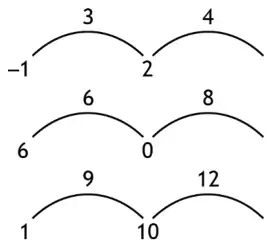 | •4 ✓ |
| G = (6,−8,22) | •5 ✓ |
Candidate F - Component form of section formula
| \(\dfrac{4(-1)+3x}{7}=2\) | |
| \(\dfrac{4(6)+3y}{7}=0\) | |
| \(\dfrac{4(1)+3z}{7}=10\) | •4 ✓ |
| G = (6,−8,22) | •5 ✓ |