
May 2025 Paper 2 Q14
14. Circle C1 has equation \((x+5)^2+(y-6)^2=9\).
(a) State the centre and radius of C1. [2]
Circle C2 has equation \(x^2+y^2-14x+6y+54=0\).
(b) State the centre and radius of C2. [2]
Circles C1, C2 and C3 are touching as shown in the diagram.
The centre of circle C3 lies on the line joining the centres of C1 and C2.
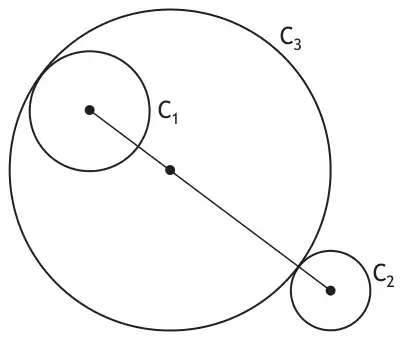
(c) Determine the equation of C3. [3]
| Mark | Generic scheme | Illustrative scheme |
|---|---|---|
| •1 | state coordinates of centre | (−5, 6) |
| •2 | state radius | 3 |
| (2) |
Notes:
- Accept \(x=-5,\ y=6\) for •1.
- Do not accept ‘\(a=\ldots,b=\ldots\)’ or ‘−5,6’ for •1.
| Mark | Generic scheme | Illustrative scheme |
|---|---|---|
| •3 | find coordinates of centre | (7, −3) |
| •4 | find radius | 2 |
| (2) |
Notes:
- Accept \(x=7,\ y=-3\) for •3.
- Do not accept ‘\(g=\ldots,\ f=\ldots\)’ or ‘7,−3’ for •3.
- Do not penalise candidates who treat negatives with a lack of rigour when calculating the radius. For example, accept \(\sqrt{7^2+3^2-54}=2\) or \(\sqrt{7^2+-3^2-54}=2\) or \(\sqrt{-7^2+3^2-54}=2\) for •4. However, do not accept \(\sqrt{7^2-3^2-54}=2\) for •4.
Commonly Observed Responses:
Candidate A - repeated error within a question
| (a) −5,6 | •1 ✗ |
| (b) 7,−3 | •3 ✓1 |
Candidate B - two errors
| (a) 5,−6 | •1 ✗ |
| (b) 7,−3 | •3 ✗ |
| Mark | Generic scheme | Illustrative scheme |
|---|---|---|
| •5 | find distance between centres of C1 and C2 | 15 |
| •6 | calculate radius of C3 | 8 |
| •7 | find centre of C3 and state equation of C3 | (−1, 3) stated explicitly and \((x+1)^2+(y-3)^2=64\) |
| (3) |
Notes:
- •5 may be awarded for \(\sqrt{(-5-7)^2+(6+3)^2}\) within a valid calculation for the radius of C3.
- •6 is only available where a valid approach to finding the distance between the centres of C1 and C2 has been used.
- Where candidates use a radius without valid supporting working, •7 is not available.
- Accept the centre of C3 written as a position vector.
Commonly Observed Responses:
Valid approaches for finding \(r\)
| \(r=\dfrac{15+3-2}{2}\ \therefore\ r=8\) | •6 ✓ |
| \(r=\dfrac{\sqrt{(7+5)^2+(6+3)^2}+3-2}{2}\ \therefore\ r=8\) | •5 ✓ •6 ✓ |
| \(r=3+3+\dfrac{(13-9)}{2}\ \therefore\ r=8\) | •6 ✓ |
| Let \(x=r_3-r_1\). Since \(r_3=13-x\), \(x=(13-x)-3\ \Rightarrow\ x=5\ \therefore\ r=8\) (may also use \(y+3=r_3-r_1\)) | •6 ✓ |
This list is not exhaustive
Invalid approaches and/or insufficient communication for finding \(r\)
| \(r=3+3+2\ \therefore\ r=8\) | •6 ^ |
| gap \(=2\ \therefore\ r=10-2\ \therefore\ r=8\) | •6 ^ |
| \(r=\dfrac{15}{3}+3\ \therefore\ r=8\) | •6 ^ |
| Distance = 15 \(\therefore\ r=8\) (with no supporting working) | •6 ^ |
This list is not exhaustive
Valid approaches for finding centre of C3
| Ratio \(=1:2\ \therefore\) C3\((-1,3)\) | |
| C3\(\left(-5+12\times\dfrac{1}{3},\,6-9\times\dfrac{1}{3}\right)\ \therefore\) C3\((-1,3)\) | |
| Ratio \(=15:10\) & stepping out \(\therefore\) C3\((-1,3)\) (may be drawn as similar triangles) | |
| Let \(x=r_3-r_1\). Since \(r_3=13-x\), \(x=(13-x)-3\ \Rightarrow\ x=5\) \(\Rightarrow\) Ratio \(=5:10\ \therefore\) C3\((-1,3)\) (may also use \(y+3=r_3-r_1\)) | |
| \(2\overrightarrow{\text{C}_1\text{C}_3}=\overrightarrow{\text{C}_3\text{C}_2}\ \therefore\ \text{C}_3=\begin{pmatrix}-1\\3\end{pmatrix}\) |
This list is not exhaustive
Invalid approaches and/or insufficient communication for finding centre of C3
| \(m_{\text{C}_1\text{C}_2}=-\dfrac{3}{4}\ \therefore\ \text{C}_1(-5,6)\to\text{C}_3(-1,3)\) | •7 ✗ |
| \(\dfrac{y-6}{x+5}=\dfrac{-3-y}{7-x}=-\dfrac{3}{4}\ \therefore\ \text{C}_3(-1,3)\) | •7 ✗ |
| \(\{3,4,5\}\) triangle with no evidence of a ratio \(\therefore\) C3\((-1,3)\) | •7 ✗ |
This list is not exhaustive