
May 2025 Paper 2 Q8
8. E,ABCD is a rectangular-based pyramid as shown.
\(\overrightarrow{\text{AD}}=6\mathbf{i}+4\mathbf{j}+2\mathbf{k}\)
\(\overrightarrow{\text{DC}}=2\mathbf{i}-4\mathbf{j}+2\mathbf{k}\)
\(\overrightarrow{\text{DE}}=-4\mathbf{i}-3\mathbf{j}+4\mathbf{k}\)
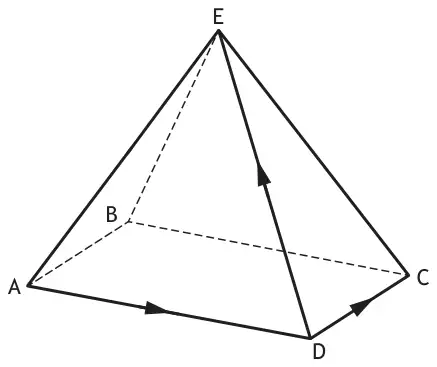
Express \(\overrightarrow{\text{BE}}\) in terms of \(\mathbf{i}\), \(\mathbf{j}\) and \(\mathbf{k}\). [2]
| Mark | Generic scheme | Illustrative scheme |
|---|---|---|
| •1 | identify an appropriate pathway | eg \(\overrightarrow{\text{BC}}+\overrightarrow{\text{CD}}+\overrightarrow{\text{DE}}\) stated or implied by •2 |
| •2 | find \(\overrightarrow{\text{BE}}\) | \((0\mathbf{i}+)\,5\mathbf{j}+4\mathbf{k}\) |
| (2) |
Notes:
- Do not penalise inconsistent vector notation (for example lack of arrows or brackets).
- •1 is not available for \(\overrightarrow{\text{BD}}+\overrightarrow{\text{DE}}\) or \(\overrightarrow{\text{BC}}+\overrightarrow{\text{CE}}\) or similar. However, see Candidate C.
- •2 is only available where a valid pathway has been stated.
- Do not accept \(\begin{pmatrix}0\mathbf{i}\\5\mathbf{j}\\4\mathbf{k}\end{pmatrix}\) or \(\begin{pmatrix}0\\5\\4\end{pmatrix}\) for •2.
- Where an invalid pathway ‘leads’ to \(5\mathbf{j}+4\mathbf{k}\) award 0/2.
Commonly Observed Responses:
Candidate A - using given vectors
| \(\overrightarrow{\text{BE}}=-\overrightarrow{\text{DC}}+\overrightarrow{\text{AD}}+\overrightarrow{\text{DE}}\) | •1 ✓ |
| \(5\mathbf{j}+4\mathbf{k}\) | •2 ✓ |
Candidate B - using given vectors
| \(\overrightarrow{\text{BE}}=(6\mathbf{i}+4\mathbf{j}+2\mathbf{k})-(2\mathbf{i}-4\mathbf{j}+2\mathbf{k})+(-4\mathbf{i}-3\mathbf{j}+4\mathbf{k})\) | •1 ✓ |
| \(\overrightarrow{\text{BE}}=\begin{pmatrix}6\\4\\2\end{pmatrix}-\begin{pmatrix}2\\-4\\2\end{pmatrix}+\begin{pmatrix}-4\\-3\\4\end{pmatrix}\) | •1 ✓ |
Candidate C
| \(\overrightarrow{\text{BD}}+\overrightarrow{\text{DE}}\) | |
| \(\overrightarrow{\text{BD}}=4\mathbf{i}+8\mathbf{j}\) | •1 ✓ |
| \(\overrightarrow{\text{BE}}=5\mathbf{j}+4\mathbf{k}\) | •2 ✓ |